Showing posts with label Reviews. Show all posts

Thursday, April 14, 2016

Books I Love - I Am Legend by Richard Matheson

I Am Legend is one of my all-time favorite books. Key word: book. Forget about that movie. What movie? There wasn't any movie!

(Actually, this novel by Richard Matheson has not one, not two, but four film adaptations...)

Here is the book description from Goodreads:

Robert Neville is the last living man on Earth... but he is not alone. Every other man, woman and child on the planet has become a vampire, and they are hungry for Neville's blood.

By day he is the hunter, stalking the undead through the ruins of civilisation. By night, he barricades himself in his home and prays for the dawn.

How long can one man survive like this?

I Am Legend is the best vampire novel I have ever read (step aside Mr. Stoker!), and it's all due to the atmosphere. The author creates a suffocating environment charged with loss, guilt and helplessness, in which we follow Neville through his day-to-day repairing his home, scavenging for food, and hunting down and killing as many vampires as possible before the sun sets.

Once the final rays of light vanish from the sky, Neville's nightmare deepens. The vampires thirsty for his blood are neighbors--neighbors who know his name and pound on his door and beckon him to come out. It's enough to drive you insane. And that's just what happens to Neville.


Grasping for his sanity, he turns to science. Here came the best part of the novel: Neville attempts to find a medical explanation for vampires. From the loathing of garlic to the fear of religious symbols, Neville researches and teaches himself about biology and technical equipment in an attempt to uncover reasons--or a cure--for this worldwide outbreak. He snags vampires and takes samples from them, analyzes their blood, and finds something very peculiar...

I Am Legend is a compelling view into the psyche of the last man on Earth. The fact that you, the reader, are all alone with Neville for the vast majority of the novel sucks you that much deeper into his world of despair. Is fighting worth it? What's there left to fight for? What's life worth, if it's surrounded by death? If the future only holds death?


Tuesday, March 15, 2016

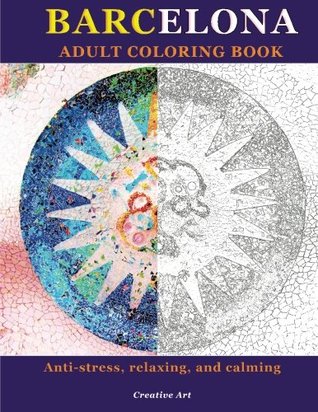
Review - Barcelona Adult Coloring Book

Barcelona Adult Coloring Book by Alexandru Ciobanu is a wonderful idea--just fabulous! Imagine coloring in all the Catalan works of art! Those mosaics! Those buildings!

If you know a little bit about me, you probably already know I live in the Barcelona area. I love this city, its history, its architecture, its daily bustle...

M'encanta Barcelona!

I received a free PDF copy of this book from the author through a Librarything giveaway, all in exchange for an honest review. Here goes the honest review.

When I saw the listing for this book on Librarything, I practically tripped over my own fingers in my haste to click to enter the giveaway. As I live near Barcelona and am a huge fan of the city, I couldn't wait to get my hands on a coloring book dedicated to my beloved Ciutat Comtal.

Unfortunately, I wasn't so happy when I looked inside. The photographs are excellent. The color and angle of each photo is exquisite. The so-called drawings, however, leave much to be desired. I refer to the drawings as "so-called" because, while the book's Amazon description uses this term, in reality the images given to us to color are no more than the result of filtering the photographs.

The filter used resembles the pencil sketch filter you can find on Photoshop. Here's a quick tutorial by Lesa Snider on Macworld on how to transform any photograph into a pencil sketch. As you can see, the process isn't too difficult once you have an idea of how Photoshop works. (I personally used to mess around with the program's filters for hours and hours.)

I don't see any problem with using a filter to modify the original photographs and turn them into something someone can color in. However, while looking through the coloring book, I felt it had been put together with haste. In general, the filtered images contain residual dots and lines that should have been cleaned up to make coloring them easier. Take this image of the antenna at the Parc Olímpic, for example:

Part of the original photograph.
Part of the image to color in. The sky around the antenna
hasn't been cleaned up, so we can see remains of the thin clouds
and airplane trails, which give the image an unfinished feel.

This happens throughout the book. Other photographs contain segments which are slightly overexposed, or too dark. The filtered image can't capture the lines if the original is too light or too shadowed, so we have sections where we encounter white spaces. For example, look at the filtered image of the mosaic on the book's cover:

The section on the left is lost
through the filtering process.

Overall, I'm sad. I so wanted to love this book. The idea is wonderful. The original photographs are excellent. The drawings are disappointing. In my case, instead of relaxing, I found them a bit frustrating and I realized my heart rate was going up while attempting to color them because I couldn't ignore the fact that they all looked dirty. There are a couple close-up images of mosaics which are just beautiful, and these work very well to color in.

Gorgeous!
Even so, just compare Barcelona Adult Coloring Book to Fantastic Cities: A Coloring Book of Amazing Places Real and Imagined by Steve McDonald, and you'll see a huge leap in quality.

In conclusion, with a little more touching up, Barcelona Adult Coloring Book could be a great pastime. Unfortunately, the way it's available right now, I can't give it any more than two and a half Pirates.


Sunday, March 15, 2015

2015 RR - The Vision by Dean Koontz

I'm no Dean Koontz fan, but I somehow ended up with four or five of his novels in my home library. The third book I tackled for my 2015 Reading Resolution is The Vision. For the life of me, I couldn't find an online image of the edition I have (a 1987 reprint), so I took a picture myself.

What can I say about this book? Hmmm... Uh... It reads quickly? I actually abandoned it several years ago due to the painful dialogues, and only read it now to complete my resolution. Needless to say, I didn't enjoy it.

Plot

Mary, best-selling author who lives with her new husband Max in Bel Air, is a clairvoyant who visualizes murders before (and sometimes while) they occur. She helps police intercept the killers before they can continue their rampage. However, one day Mary's visions change: she can feel the pain of the victims and she fears for her life. It seems the murderer knows she's observing him, and is after her.

Pros

A quick, effortless read.

Cons

There are so, so many things I didn't enjoy about this book. For the sake of brevity, I'll give you a list of my top peeves.

1) The story itself it crammed with clichés up until the final showdown with the villain, who (of course) takes the time to give a fully detailed recount of all his antics and motives before swooping in for the final kill.

2) The characters feel like paper cutouts and constantly share "as you know, Bob" conversations. It's ridiculous to read page after page of characters explaining things to each other--things they both already know! There has to be a more elegant way to transmit back story. I'd prefer a simple narrative paragraph every now and then instead of having the characters talk to each other like they're all going through acute bouts of amnesia.

3) The writing style itself is sometimes irritating. In this novel, Koontz seems to have developed some sort of allergy to conjunctions. What happened to the humble "and"? Gone. Here are some examples:

     - He sat up, switched on the lamp, looked around the room.
     - He let go of her wrist, pushed his hair back from his forehead.
     - At last the intense, dark-skinned young man stood up, helped the blonde to her feet.

I wouldn't mind if these parallel structures appeared every now and then, but here we're talking about page after page.

4) Another problem I have is the amount of scene breaks. The novel feels like it was written for a TV drama. We get two paragraphs, scene break, two more paragraphs with the same character five minutes later, scene break. Is it really necessary to cut scenes every time a minute goes by? Where's the flow? Just have a look at page 189 of my edition:

  7:00 P.M.
     Mary squeezed Max's hand and waited tersely. Any minute the walkie-talkie would crackle with a report from one of the deputies. [One more longish sentence.]
  7:03.
     Mary repeatedly glanced at her watch in the back glow of the police cruiser's headlights. She shifted restlessly from one foot to the other.
  7:04.
     For the first time in more than an hour, Chief Patmore looked at her, met her eyes. He wasn't happy.
  7:06.
     She was beginning to feel that she had been outmanoeuvred, outwitted. [Two more sentences.]
  7:09.
     She was numb with fear. "Something's wrong," she said.
     "What is it?" Max asked.
     [Scene continues for a very brief conversation and then we cut again to 7:30.]

In this case, the cuts are meant to increase tension, but come on. I just--I just can't. No. Really. I can't.

5) The author attempts to slip the reader a big fat red herring, but in my opinion fails miserably. So much attention is drawn to a single character in an attempt to make the reader think he's the culprit, that it quickly becomes uncomfortable and embarrassing.

The Vision is one of Koontz's earlier works--but not his first. Have another look at that cover. Yeah, it boasts he's the author of Strangers and Darkness Comes. Inside the book, we have a list with a total of seven Koontz titles. So, The Vision might be an early Koontz novel, but with seven others under his belt, I would hardly call it the work of an amateur.


*Sigh*

I'm not a big fan of giving bad reviews, but I can't lie, either. At least it's a quick, mindless read.


Bonus rant round!

Take a load of this conversation from page 20:

     "What a mayor you are," [Harry Oberlander] said with heavy sarcasm. "Hiring a witch to do police work."
     Henderson responded like a weary giant spotting yet one more tiny challenger with delusions of grandeur. "She's not a witch."
     "Don't you know there's no such thing as a witch?"
   
What did I just read? Oberlander accuses Henderson of hiring a witch. Henderson responds that she isn't a witch. Oberlander reminds Henderson that witches don't exist. Then why does he even accuse Henderson of hiring a witch in the first place?


Final round: The Longest Sentence in the History of Sentences

I'm not saying this sentence is bad. It does its task perfectly and really sets the scene. Do you want to read it? Do you? It contains spoilers, so only proceed if you dare.

Pages 244-245:

     Even before he completed the thought, the knife ripped into him, rammed out of darkness and into him, felt like the blade of a shovel, enormous, devastating, so devastating that he dropped the gun, feeling pain like nothing he'd ever known, and he realised that the killer had pitched the flashlight aside as a diversion, hadn't really been hit at all, and the knife was withdrawn from him, and then shoved hard into him again, deep into his stomach, and he thought of Mary and his love for Mary and about how he was letting her down, and he grappled with the killer's head in the dark, got handfuls of short hair, but the bandage came off his finger and the cut was wrenched open again and he felt that pain separate from all the others and he cursed the sharp edge on the car's jack, and the flashlight his the floor ten feet away, spun around, cast lunatic shadows, and the knife ripped loose from him again, and he reached for the hand that held it, but he missed, and the blade got him a third time, explosive pain, and he staggered back, the man all over him, the blade plunging again, high this time, into his chest, and he realised that the only way he could hope to survive now was to play dead, so he fell, fell hard, and the man stumbled over him, and he heard the man's rapid breathing, and he lay very still, and the man went for the flashlight and came back and looked down at him, stood over him, kicked him in the ribs, and he wanted to cry out but didn't, didn't move and didn't breathe, even though he was screaming inside for breath, so the man turned away and went towards the arch, and then there were footsteps on the tower stairs, and, hearing them, he felt like such a useless ass, outsmarted, and he knew he wasn't going to be able to recover his gun and climb those stairs and rescue Mary because stuff like that was for the movies, pain was pulverizing him, he was leaking all over the floor, dripping like a squeezed fruit, but he told himself he had to try to help her and that he wasn't going to die, wasn't going to die, wasn't going to die, even though that was exactly what he seemed to be doing.

And that's it for The Vision! I haven't had much time to post on the blog recently, but I have had time to read. I just finished the fourth book in my 2015 Reading Resolution list: The Princess Bride. Well...I finished the main story but still had to read the epilogue of sorts, and then my cat puked on the book so now I'm not sure if I actually got the nerve to finish those last pages...

Thursday, January 29, 2015

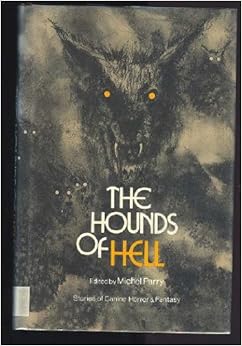
2015 RR - The Hounds of Hell

Oh, happy day! Today I finished the second book from my 2015 Reading Resolution list!

The Hounds of Hell: Stories of Canine Horror and Fantasy, edited by Michel Parry, receives a solid four-star review from me.

Let's begin with the basics. The short stories in this collection all revolve around canines, be they good, evil, spectral, or even real pets. The book I own is the hardcover 1974 edition (I have a soft spot for older books versus newer editions). Most of the stories therein range from the early to mid twentieth century--probably my favorite decades for fantasy and horror.

Some of the stories are entertaining, some pull you right in...and others fall flatter than a pancake. Did I say pancake? No. Something even flatter. A crepe. Stick with me and you'll see.

Let's have a quick roll call, shall we? I'll include the story's title, author, and first sentence, along with my personal verdict.

The Hound, by H.P. Lovecraft
In my tortured ears there sounds unceasingly a nightmare whirring and flapping, and a faint, distant baying as if of some gigantic hound.

KVerdict: Not bad, although Lovecraft 's flowery style does get to me sometimes (I know, the time period...). I have several of his books, but sadly am not a great fan of his work. This story isn't an exception. It's just all right.

Staley Fleming's Hallucination, by Ambrose Bierce
Of two men who were talking one was a physician.

KVerdict: The first of many stories in this collection to have someone stalked by a phantom dog and ultimately get their throat ripped out. *Yawn.*

The Dog, by Ivan Turgenev
"But if you once admit the existence of the supernatural, and that it can enter into the ordinary affairs of everyday life, allow me to ask what scope is left for the exercise of reason?"

JVerdict: An excellent story with a rather slow opening. The Dog has the honor of being the only story to make a chill run through me. Once again, the character is stalked by a dog during the night. This dog, however, is warning him of what's to come...

The Hound of Death, by Agatha Christie
It was from William P. Ryan, American newspaper correspondent, that I first head of the affair.

KVerdict: A nun dreams of things which she believes never existed, but seem more real to her than life. Could she be remembering backwards?--Seeing what's to come? The symbolism, the premonitions, the signs... There is a distinct cult feel around this story, which nonetheless lacks something, as if it weren't completely fleshed out.

Dead Dog, by Manly Wade Wellman
They brought the rebel chief Kaflatala out of the jungle to Father Laboissier's mud-brick house, brought him in a tepoia because he still limped from a Portuguese bullet in his thigh.

JVerdict: Although Dead Dog repeats the premise of a person being stalked at night by a vengeful hound, the African setting, so different from the other stories in the collection, made for an interesting read.

The Dutch Officer's Story, by Catherine Crowe
"Well, I think nothing can be so cowardly as to be afraid to own the truth," said the pretty Madame de B., an Englishwoman, who had married a Dutch officer of distinction.

KVerdict: A ghostly hound wakes up sentries who are asleep on their watch, so of course someone higher up decides to see what happens if he shoots the creature. I don't understand why so many of the characters in these stories feel the need to shoot at dogs.

Vendetta, by Guy de Maupassant
Palo Saverini's widow dwelt alone with her son in a small, mean house on the ramparts of Bonifacio.

KVerdict: This is one of the few stories where the dog is a regular, living breathing pet--trained to kill.

Dog or Demon? by Theo Gift
"The following pages came into my hands shortly after the writer's death."

JJVerdict: Excellent storytelling by Victorian novelist Dora Havers (under a male pen name, of course). Probably what I loved most about this story is the fact that, even though it takes place in 1878 Ireland, the topic of eviction (with all its paperwork and personal drama) is so similar to what could happen nowadays--if you don't include the curses and the phantom killer dog (again).

Louis, by Saki
"It would be jolly to spend Easter in Vienna this year," said Strudwarden, "and look up some of my old friends there."

JVerdict: At first I was a bit disgusted. Murder your wife's beloved pet just to be able to go on vacation? However, once the murder plan is carried out and the truth is discovered, the story deserves a chuckle.

The Howling Tower, by Fritz Leiber
The sound was not loud, yet it seemed to fill the whole vast, darkening plain, and the palely luminous, hollow sky: a wailing and howling, so faint and monotonous that it might have been inaudible save for the pulsing rise and fall; an ancient, ominous sound that was somehow in harmony with the wild, sparsely vegetated landscape and the barbaric garb of the three men who sheltered in a little dip in the ground, lying close to a dying fire.

JJVerdict: The protagonists of this story, Grey Mouser and Fafhrd, are the protagonists of a series of short stories. The Howling Tower starts off a bit slow, and the point of view is so distant it's at times difficult to grasp, but once the action begins it's a tale full of imagination that I won't mind reading again.

The White Dog, by Feodor Sologub
Everything grew irksome for Alexandra Ivanova in the workshop of this out-of-way town--the pattens, the clatter of machines, the complaints of the managers; it was the shop in which she had served as an apprentice and now for several years as seamstress.

LVerdict: This is probably the flattest story in the entire collection. The beginning is all right and promises something like revenge or at least a good fight between Alexandra and a Tanechka, the youngest seamstress. What follows, however, is just awful. I'll just explain it, so if you don't want any spoilers please stop reading here. After being called a dog by Tanechka, Alexandra goes into a rage and returns home, where she ponders her existence and the round, full moon. There is ambiguity about whether or not she is a shape shifter. Driven by a force stronger than her will, Alexandra tears off her clothes and runs outside, where she lies on the ground and howls at the moon. Two neighbors see what they believe is a massive white dog, so logically (¿?) they run out and shoot it...

"The discharge of a rifle sounded in the night air. The dog gave a groan, jumped on its hind legs, became a naked woman who, her body covered with blood, started to run, all the while groaning, weeping and raising cries of distress. The black-bearded one and the curly-headed one threw themselves in the grass and began to moan in wild terror." THE END

Seriously? Put some Nutella on that crepe and serve it to me hot.

The Hound, by William Faulkner
To Cotton the shot was the loudest thing he had ever heard in his life.

KVerdict: I could have enjoyed this American South story more if the writing weren't so disjointed. There are several passages--especially descriptions of places and series of actions--where it seems the author just skipped over entire sentences. I don't know if this style is intentional to fit the protagonist, but it made for a confusing read.

The Emissary, by Ray Bradbury
Martin knew it was autumn again, for Dog ran into the house bringing wind and frost and a smell of apples turned to cider under trees.

JJVerdict: An excellent story told in an excellent voice--probably, my favorite from the collection, in fact. Little boy Martin is perpetually sick and bed-ridden, but his faithful Dog tells him everything of the outside world through the smells and brambles (and other stuff...) he brings back in his fur. The ending had a very strong Pet Sematary feel to it, which was juuuuust fine.

The Hound of Pedro, by Robert Bloch
They said he was a wizard, that he could never die.

JVerdict: Another excellent story revolving around wizardry and black magic, this time in 1717 Mexico. The depictions of violence and cruelty are exceptionally vivid in this one, so it's not for the faint of heart.

The Whining, by Ramsey Campbell
When Bentinck first saw the dog he thought it was a patch of mud.

LLVerdict: Horrible! Awful! I never want to read this again! When I began reading this collection, I had some reservations as I was worried that some of the stories might depict cruelty to a "real" (not phantom, not satanic) dog. This story fed my fears. And of course, the protagonist loses his marbles in the last line or two. How convenient. Nope.

The Death Hound, by Dion Fortune
"Well?" said my patient when I had finished stethoscoping him, "have I got to go softly all the days of my life?"

JJVerdict: Once again, an excellent story told by an excellent storyteller, Violet Wirth, "the most influential female occultist since Madame Blavatsky." The Death Hound features occult detective Doctor Taverner, who uses his wit and a dose of white magic to thwart an attempt at mental assassination. How come I never heard about this author or this character before? *Runs off to find more Taverner stories!*


And that concludes my analysis of The Hounds of Hell. Overall, it was an enjoyable read, though the topic of killer dogs did become a bit repetitive (I can't blame anyone--it's a collection of stories about killer dogs!). The best result of reading this collection is that now I know more authors and more characters I can look up. Doctor Taverner, here I come!

Would you like to read The Hounds of Hell?

What book should I strike off my list next? I was thinking about reading The Vision by Dean Koontz, merely because it's completely different to what I just read. However... I remember the first pages being so sappy... I guess I'll have to soldier on through it, right?
Thursday, January 22, 2015

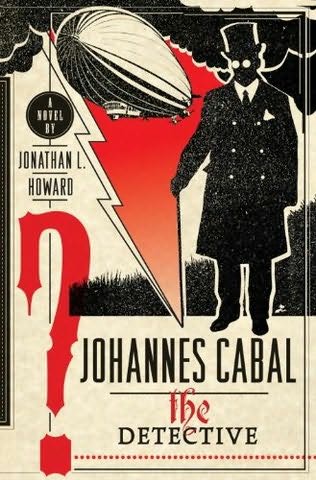
2015 RR - Johannes Cabal the Detective

Driven by guilt and a little bit of shame, I recently resolved to finish reading all the unfinished books in my home library.

The first book I can happily and with a great sense of completion strike off the list is Johannes Cabal the Detective by Jonathan L. Howard.

Back in the day, I happened across the prequel, Johannes Cabal the Necromancer, in my local bookstore (which is great since I live in Spain and the English novel section of my nearest bookstore is usually packed with gaudy best-sellers I'm not inclined to read). I thoroughly enjoyed the read and fell in love with the antihero protagonist, his vampiric brother, and the magic involved in their adventures. There was a slight hiccup nearing the end of the novel, though: the author suddenly shifted full point of view to the so-called antagonist (a police officer), and my God was it dull!

Nevertheless, I finished the novel and was thrilled to hear a second part would soon come out. Johannes Cabal the Detective is the first and only novel I've ever--EVAAARRR!--pre-ordered on Amazon.

When the lucky book finally arrived, I jumped right into it, but unfortunately I abandoned all hope at around chapter eight. Well, it's 2015 now and it's time to give the novel a decent ending.

I finished reading Johannes Cabal the Detective last night. Final verdict: all right, but lacking much of the charm from the first novel (probably because the antihero's brother doesn't appear). What's more, as the title blatantly points out, this novel is a whodunit crime investigation--and that just ain't my cuppa tea.

Let me go through some highlights, and some hurdles. Hurdles first!

In my opinion, the entire novel suffers from a lack of focus. The author is just so utterly long-winded! The point of view jumps all over the place at all times, which doesn't help, either. I've had to reread several sentences more than once because I continually got lost in circuitous sentence structures. I believe a one-paragraph example is sufficient to give you a sense of the prose:

  "Well, Herr Harlman," said Cabal as he fitfully considered escape plans without any general enthusiasm. The whole concourse was surely dense with assorted secret policemen just itching for an excuse to kick his spleen into sausage meat. The fact that he was being treated to coffee rather than being bundled into the back of an unmarked van by several burly servants of the state armed with overactive thyroids and lengths of rubber hose implied that the covert machinations of Senza were handled with rather more civility than those of its neighbours, as well as subtlety. He could barely believe that he had so utterly failed to spot the trap. Therefore, he decided, he would wait for the scale of the operation he had wandered into to become apparent before giving and bright ideas for escape serious consideration. "What happens now?"

[Pages 292-293 of my 2011 paperback edition]

Yes, that is all presented as one giant paragraph, with a tiny bit of dialogue tacked onto either end.

See what I have to deal with here? Extreme cases of wordiness such as this, plus a whodunit theme which has never really interested me, are the two main reasons why I abandoned Johannes Cabal the Detective. Am I glad I reprised my read? Sure! The author and the protagonist deserve that much. To be honest, now that I've completed this novel I'm actually toying with the idea of tackling the third book, Johannes Cabal: The Fear Institute. At least the title sounds more up my alley.

Now for the novel's highlights!

Johannes Cabal continues to be a fascinating sick bastard of a man. He's the typical antisocial supercilious antihero, and that's what I simply adore about him. His eccentric and generally chill-inducing personality aside, he's fighting for a very personal cause--an excellent cause which I won't reveal here, but which just goes to show that even cold-hearted bastards can have a shred of humble humanity in them.

Jonathan L. Howard might be long-winded and at times frustrating (at least to me), but he is also an excellent author with a delicious range of vocabulary. Howard has a spellbinding way of explaining the inexplicable. Here's an excerpt that had me completely hooked:

  The room stank like a laboratory fire, and the thick chemical fug made Miss Barrow's eyes sting. Cabal ignored it all, his own eyes screwed shut as he chanted and chanted a seemingly endless litany of inhuman words from an inhuman religion. They were awful words, incomprehensible to her, but jagged, ugly things that he spat out like stones and razors. That he knew them by heart did not escape her, and she feared him for that, for it showed depths in him that opened into the abyss. Nor did he hesitate when Cacon's heels began to rattle on the floor, his legs spasming like the galvanised corpse of a frog on a school science bench. It was death, but it was in reverse, and the most obscene abrogation of the laws of nature she could ever imagine. Life did not return easily to the carcass, but was bullied and coerced, and what little dignity there is in death was torn and tattered by this sordid reversal. Cacon seemed to swell with something that was just close enough to life to serve, but equally, she sensed in her every fibre that it was a poor sort of stopgap and that it would leak away again soon enough. When Cacon started to shake and suck in ragged, dry breaths, she shuddered with revulsion, but she could not stop watching.

[Pages 250-251]

Yes, I'm aware this excerpt is another massive single paragraph, but this one held my attention through and through and wowwie, Batman! *Round of applause.*

Overall, I would give Johannes Cabal the Detective a 3.5. Not bad, but it could have been better if many things had been more to-the-point.


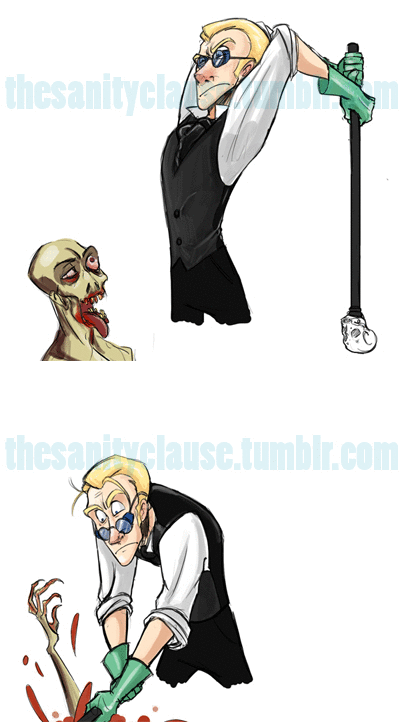
HarpyMax has some excellent Cabal fan art.
First book off my list! Yay! I think I'll go for something completely different next. How about... The Hounds of Hell, Stories of Canine Horror and Fantasy?

Monday, January 19, 2015

2015 Reading Resolution

Happy New Year! About three weeks late but oh, well... Better late than never, right?

Let's get straight to today's business: my 2015 Reading Resolution.

Here's a picture of my library:


As you can see, it's quite packed. I have well over two hundred books, and unfortunately some of them are still unread. So, for this year, I resolve to...


Here are the unlucky unread (for this selection I'm not counting my collection of antique books because I don't want them to fall apart):


Note: I will add links to reviews as I finish reading the books.

Never started:

- Lightning by Dean Koontz
- Velocity by Dean Koontz (I'm not a big fan of this author...)
- The Scarlet Letter by Nathaniel Hawthorne
- Modern Classics of Science Fiction, edited by Gardner Dozois
- The Hounds of Hell, Stories of Canine Horror and Fantasy, edited by Michel Parry
- Foundation and Chaos (The Second Foundation Trilogy) by Greg Bear (Sent to me by mistake by an Amazon seller.)

Abandoned before finishing:

- Johannes Cabal the Detective by Jonathan L. Howard (I absolutely loved the first book but couldn't get into this one.)
- The Vision by Dean Koontz
- Ender in Exile by Orson Scott Card
- The Left Hand of God by Paul Hoffman
- The Shelters of Stone by Jean M. Auel
- The One-Hundred-Year-Old Man Who Climbed Out the Window and Disappeared by Jonas Johansson (It was horrible.)
- The Wise Man's Fear by Patrick Rothfuss (not in the photo)

Recent acquisitions:

- The Princess Bride by William Goldman
- A Clockwork Orange by Anthony Burgess
- Neverwhere by Neil Gaiman

I think I got my work cut out for me! Just this list contains sixteen titles, plus I recently began collecting the Fullmetal Alchemist Kanzenban Edition graphic novels (up to number five), so I think this year will be packed with reading. That's good because, to be honest, I barely read anything last year since I was so busy writing. This year isn't an exception (I have to publish Making Time!), but I promise to make an effort and step up to the challenge!

Which book should I strike off this list first? Have you read any of these? I think I'll begin with one I left halfway through... Hmmm... Maybe the Johannes Cabal one... What about you? Do you have any reading resolutions for 2015?

Thursday, December 11, 2014

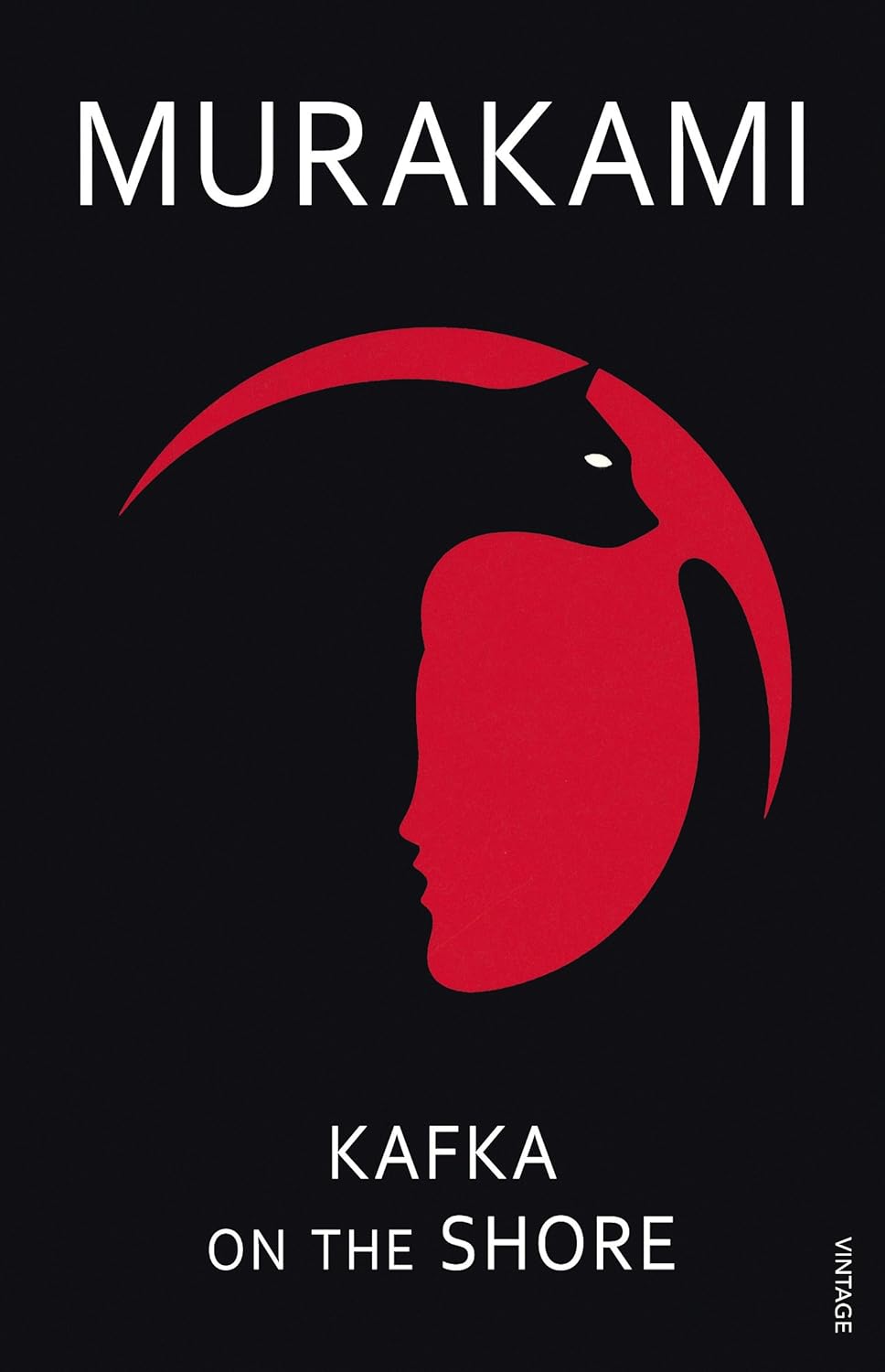
Review: Kafka on the Shore

**SPOILERS**

I'm officially disgruntled. You might have seen my recent post Review As You Read, in which I blundered through most of Kafka on the Shore and wrote a vague summary (didn't want to give things away) along with my reactions (I was equally pleased and bored).

Now that the story is over, I'm neither pleased nor bored. I'm frustrated.

Let me be clear: I enjoy mythology, I enjoy metaphysical meanderings, I love riddles--especially existentialist ones... Pondering my existence and treading on the verge of non-existence are themes I also investigate (to a limited degree) in my work. So why am I so dissatisfied with Kafka on the Shore?

Basically, I find it too open to interpretation. Don't get me wrong: I do enjoy open endings, but everything has to have a limit. Take the ending of the film Inception, for example. I know no movie is without sin, but I particularly enjoyed the free-interpretation ending in this flick. In my personal version, the happy ending is no more than a dream within a dream--a lie the main character tells himself. Other viewers argue that the ending is reality--check Cobb's wedding ring, etc.

In Inception we have an open ending, an unanswered riddle, and to me that's fine. Let's look at another example: Life of Pi. There is a heavy religious element (which some complain is shoehorned in), but also a gut-wrenching tale of survival. Which version of the story should we believe? Animal? Human? What really happened to Pi? Is the tiger a representation of his inner self, or was he truly on a boat with this massive feline? All unanswered questions, but not remotely as frustrating as Kafka on the Shore because, one way or another, readers can choose their own answers.

Having said that, let's return to Kafka on the Shore. Just off the top of my head:

What the hell happened to Nakata as a child? What's the meaning/use of the flute made out of cat souls? Is Johnnie Walker really Kafka's father? If so, does that make Kafka's father a cat murderer and possibly a meddler in the dark arts? Did Nakata ever manage to recover the part of himself that he lost in that freak accident we still know almost nothing about? Why'd he suddenly die? Is Colonel Sanders the same "entity" as Johnnie Walker? Why can't we get to see the flute? What the hell is that white creature that tries to go into the entrance stone? What the hell is that town hidden in the forest? Is it a sort of limbo? Other dimension? Afterlife? Too...many...frustrating...questions!

As you might have noticed, these questions don't really refer to the big picture. They're book-specific, plot-specific, however you want to call it. These are the worst, in my opinion, because they can easily make a reader feel frustrated and lose interest in the story. Their abundance makes me wonder if I might have blacked out during a few pages...or chapters. What's worse is that, as the action progresses, the questions just keep on piling up--and never get resolved! When absolutely every plot point raises a question that never gets answered, my BS meter starts to go off.

All these loose ends and unfulfilled promises build up so that by the time I reach the end of the novel I'm far from awed. I'm frustrated and not in the mood to ponder any longer--not when the questions I'm left with don't have any life-enlightening meaning to me. Not when the promise of dark fantasy (initiated by the character Johnnie Walker and his infamous soul flute) fizzles out into a mish-mash of pseudo-philosophical representations.

The answers are always just out of reach: a page away, just one more page, just a little more, then we'll finally understand. Not this page? Turn another one. Oh... Not in this chapter? Then maybe in the next one. Yeah, the next one for sure. Or not...

Let me illustrate my frustration with a sample from the book.

The last chapter contained a true kick in the gut for me. Kafka has just returned from "beyond" (whatever, whenever, and wherever the heck that is). Two WWII soldiers apparently frozen in time guard the entrance and lead Kafka back out to the cabin in the woods where he was staying. Soon, a man called Sada comes to pick him up and take him back to the library, his usual residence. This is part of the conversation that ensues:

     "Did you run across the soldiers?" Sada asks casually as if he'd asked me what time it was.
     "You mean those two soldiers?"
     "Right," Sada responds, glancing at me. "You went in that far, eh?"
     "Yeah, I did," I reply.
     His hands lightly gripping the wheel as he manoeuvres it, he doesn't respond, and his expression doesn't tell me anything.
     "Sada?" I ask.
     "Hm?" he says.
     "When you met those soldiers ten years ago, what did you do?"
     "What did I do when I met those soldiers?" he repeats.
     I nod and wait for his answer.
     He glances in the rear-view mirror, then looks ahead again, "I've never talked about that to anyone," he says. "Not even to my brother. Brother, sister--whatever you want to call him. Brother works for me. He doesn't know anything about those soldiers."
     I nod, saying nothing.
     "And I doubt I'll ever tell anybody about it. Even you. And I don't think you'll ever talk about it to anyone, either. Even to me. You know what I'm trying to say?"
     "I think so," I tell him.
     "What is it?"
     "It's not something you can get across in words. The real response is something words can't express."
     "There you go," Sada replies. "Exactly. If you can't get it across in words, then it's better not to try."

Page 496 of my edition (last chapter).

My reaction:
Are you serious? Did that just happen?

It's scenes like these which make me wonder if the author isn't having a hoot at our expense. I've seen them in book forums: loyal readers discussing and debating and picking apart every meaningless detail in an effort to understand something--anything. To me, that's grasping at straws. I'm the kind of person that wants answers. More or less straightforward answers. Maybe I'm too pragmatic. Maybe I'm too literal, though I do understand things aren't black or white but actually an ample gradient of tones of gray. People can have different answers for the same question, and they can all coexist.

Being open to interpretation isn't really the problem--I already mentioned this with examples such as Inception or Life of Pi. The problem is being too open to interpretation. So open, in fact, that the story begins to resemble more a pantomime of a riddle than an actual riddle.

Unfortunately, this is the sickening feeling I get after reading Kafka on the Shore. As I mentioned in my Review As You Read post, I generally enjoyed Nakata's chapters more than Kafka's because they were more straightforward and the action seemed to be leading somewhere. However, I felt cheated. Chapter 16 was for me a turning point in the story. Johnnie Walker needed to murder cats and devour their beating hearts in order to create a flute with the cat souls. The question is WHY? Why, God in Heaven, WHY?

Walker cruelly murders three cats as Nakata watches, helpless. Johnnie Walker wants Nakata to kill him, and finally the old man snaps and does just that. It was a shocker of a chapter, and it promised many things--things which never really came to term. Sure, Walker does make a final appearance in which the boy named Crow pecks out his eyes while he cackles with laughter. He even taunts us by mentioning that he now has the soul flute, but it's in his bag and he doesn't feel like taking it out. *Disgruntled grumbling.*

It seems we readers are always left with a sense of "aaaaaaaaaaaalmost there!" I could go on for days. That's how frustrated I am right now.

Let me finish my long list of negatives and give a quick nod to the positives: the novel does offer several beautiful passages. My favorite is when Kafka enters the forest for the first time and realizes how dangerous it truly is. The descriptions of the trees, guarding their realm, really brings the entire scene to life. Another segment I truly enjoyed appears near the beginning, in which a person's torment is compared to a sandstorm raging all around, a natural disaster we must overcome.

But that's pretty much it.

Conclusion:

Want to wonder about where we fit into the big scheme of things? Want to have your existence blown? A Brief History of Time by Stephen Hawking took me for a much wilder trip than Kafka on the Shore. Period.

Wednesday, December 3, 2014

Review As You Read - Kafka on the Shore

On November 21, 2014 I began reading Kafka on the Shore by Haruki Murakami. I'm equally thrilled and bored by the novel, and since this is quite a strange combination of sensations I thought I would share it with you all in a special post: RAYR -- Review As You Read. This post is a sort of diary where I vent out my general musings as I turn the pages of this...fantasy?...drama?...literary? novel. I'll do my best to be vague, but I should still say (just in case) SPOILER ALERT.

If you don't mind spoilers and want a chapter-by-chapter timeline, this site is excellent.

November 21 to 24

Kafka (not his real name) Tamura runs away from home on his fifteenth birthday, under the shadow of a dark prophecy (which I still don't know). This might sound a bit bland (I mean, another prophecy kid, really?), but the truth is the story has its interesting points. For example, in the very first chapter Kafka is urged on by the slightly creepy "boy named Crow," a sort of invisible...guardian? Friend? Hallucination?

Sadly, though, the following chapters were a big letdown. Kafka travels by long-distance bus and the journey is excruciatingly boring--it's like you're there with him! I guess you could say that's good... Puts us right in the scene... *sigh*

Soon after--surprise! Kafka wakes up in a garden, covered in blood, and has no idea what happened or how long he's been passed out. News breaks out that his father was stabbed to death. Hmmm... *suspicious, ain't it?*

Another main character is the old man Nakata, who experienced a very unusual accident as a child and ended up a bit dim-witted. This character is introduced for the first time through top-secret interviews (yeah, there's a whole Area 51 feel surrounding this story...). To tell the truth, at first I didn't care much for the tedious statements. However, as the unusual story unfurled, I found myself wanting to know more.

After hearing about Nakata's childhood experience, we have the pleasure of meeting him. As I mentioned, he's quite old and his delicate mental condition has him living on a government "sub city." Don't underestimate Nakata, though: there's one unique thing he can do, and that's talk to cats. Any conversation with a cat is purrrfect in my book! So far, I find Nakata's story much more engaging than Kafka's, as the old man is searching for a lost cat and comes across a very dangerous character by the name of Johnnie Walker. I'm a bit hesitant to read on, since I'm pretty sure this dangerous guy kills animals (mainly cats) for pleasure--and animal cruelty is something I absolutely cannot stomach.

Finally, I have to warn you all about a certain chapter about a library. I don't know how I pulled through. It literally sucked away my will to live and I ended up skimming a few of the pages just to get it over with. It's somewhere around chapter 3 or 4. I don't dare look back because I have the feeling that once I open those pages again the boredom will drag me down into a puddle of despair. It might just be me, but it was the most boring chapter I've ever read as far as I remember. You'll know which one it is when you come across it. Basically, Kafka investigates a library. Oh, no. The memories.

November 25


Did I say the library chapter was bad? Wait until you reach Chapter 16. It's a completely different type of bad--it's EVIL. I'll admit it's powerful. It follows Nakata on his search for the lost cat Goma into the home of Johnnie Walker, who I will now describe as Satan personified. Did I mention I can't stomach animal cruelty? I've said enough. This chapter disgusted me so much I had trouble sleeping that night--and the following night as well. However, this is for now one of the most powerful scenes I've read in the entire novel, and Walker is especially interesting. I do hope we get to learn more about him because he added a deep touch of dark fantasy to the story.

I do feel sorry for Nakata. The poor old man has been through so much--though I feel much, much sorrier for Mr. Kawamura...

November 26 to 30

Fish and leeches rain from the sky. Kafka reveals the prophecy (and it's one most of us have heard before...). Nakata, after recent horrifying events, decides to leave his neighborhood for the first time in his life. He's searching for something--though he's not sure what. As if driven by some divine force, Nakata hitchhikes his way west and eventually teams up with a young man called Hoshino, who drops everything to be his loyal follower. Together, they find the entrance stone--and open it (basically, Hoshino has to turn it over and it becomes the heaviest stone in the world). Now that the door is open...what'll happen?

So what does Kafka do while all this is going on? Basically, he makes friends with Oshima, a librarian at the famous library we read about earlier, and ends up living in the library's guest house. He learns about Miss Saeki, the head librarian, and her tragic past. Monumental coincidence: when she was younger, Miss Saeki recorded a single called Kafka on the Shore. The lyrics are the most ambiguous thing ever, but I have the suspicion we'll understand everything clearly as the pages go by.

Once again, the chapters involving Nakata overshadow the Kafka chapters, at least as far as my own personal interest goes. Kafka tells his story in the first person whereas Nakata's chapters are told in an omniscient third person narrative voice. Even so, I feel much closer and much more empathetic towards Nakata than the teenage runaway. I believe this is because Nakata sparks a sort of tenderness in me: he's sweet and naive so I want things to go well for him. Most of all, I want him to recover what he lost in his childhood accident, and I believe--hope--that's where the story is heading.

His story so far is also much more straightforward than Kafka's. Kafka's chapters involve long existentialist paragraphs, quotes from Greek plays and philosophers, and repetition of the same metaphysical questions. All this is all right--up to a point. As a reader, I usually want more action and less metaphysical moping about.

So far, I've read up to the point where Nakata and the faithful Hoshino reach the library where Kafka has been spending his days--though Kafka is away at the time because the police are searching for him regarding his strange disappearance and the even stranger death of his father.

My next post will be the conclusion and final overall opinion. Not that many pages left! I hope all the loose ends get tied up!

Friday, November 21, 2014

Review - The One-Hundred-Year-Old Man Who Climbed Out the Window and Disappeared

A good book stays with you forever. Unfortunately, sometimes bad books linger in your unconscious as well.

Today I would like to write a review on the book The One-Hundred-Year-Old Man Who Climbed Out the Window and Disappeared (dare ya' to say that five times real fast!). I had been wanting to read it for quite a while, but when I finally got my own copy... You guessed it: me no likey. Of course, what I express here is nothing more than my personal opinions and frustrations.

Have any of you read this novel? Were you able to finish it? Did you enjoy it? My responses to these questions are: I tried. No. Sort of.

What does the novel have to offer? An interesting premise: On his one-hundredth birthday, Allan Karlsson decides he's had enough of the old people's home he's in and he does just what the title promises--he jumps out the window and (as far as the authorities know) disappears. From here on, he initiates a wild adventure that will, among other things, team him up with an elephant and make him a rich man. As the story progresses, we also learn about his past as an explosives expert, a profession which took him all across the world.


Sounds interesting, doesn't it?

It would be, if the author hadn't gone out of his way to make it BORING.

Let me explain. The novel starts out all right. Karlsson escapes from the old people's home (it's always called just that: "the old people's home." No specific name, no nothing.) and makes his way to the bus station where he encounters a disgruntled youth with bathroom and suitcase problems. In the end, Karlsson gets on a long-distance bus with the young man's suitcase (he just goes ahead and steals it). What's inside? The equivalent to hundreds of thousands of dollars. What happens next is what you'd expect from any centenarian with nothing to lose:


a cold-blooded killing spree.


(And he doesn't even have a shred of guilt about any one of the deaths. Wanna know why? Because good ol' Allan Karlsson is a freaking psychopath!)

Now, I'm not a prude. I've read my share of adventure, sci-fi and fantasy in which blood is poured over several pages. However, what startles me about The One-Hundred-Year-Old Man is:

1) The deaths are obviously meant to be the humorous parts of the story.
2) None of the characters--not Karlsson, not even the other people who eventually team up with him--seem to care the slightest that they are terminating human lives.

Now, you might shake your head and say "But Nadine, get your adjectives straight! You said the story was boring! What's boring about this?" Let me explain: the author apparently does everything he can to make the would-be adventure/killing spree dull.

Would you like an example? The vast majority of the story is told in reported speech:

     They had a late evening at Bellringer Farm with one and all in very good spirits. Amusing stories were trotted out one after the other. Bosse was a hit when he pulled out the Bible and said that now he would tell them the story of how he, quite involuntaringly, came to read the whole book from beginning to end. Allan wondered what devilish method of torture Bosse had suffered, but that wasn't what lay behind it. No outsider had forced Bosse to do anything, No, [sic] Bosse's own curiosity was responsible .
     -- I'm sure I'll never be that curious, said Allan.
     Julius asked whether Allan could stop interrupting Bosse for once so that they could hear the story, and Allan said he could.

This is a typical sequence taken straight out of the novel (page 237 of my edition--cover image above). The problem with using so much reported speech is that readers can't really get a sense of the characters because we can't hear them. We only hear the narrator--whoever that is--explain a story to us.

There are some rare instances where we readers can delight in morsels of direct speech, but the author can't even get that right... Now, this might actually be a translation error, but the dialogue starts off between quotation marks, and then suddenly shifts to em dashes (the same way dialogue is represented in Spanish). Why the sudden change in punctuation? Where's the sense in that?

If the use and abuse of reported speech weren't enough, the author rams certain character details down our throats so many times that "repetitive" becomes an understatement (Karlsson like to drink, Karlsson doesn't care about politics, Karlsson has no sex drive--I get it already! No need to hammer in the character profile every dozen pages!)

The One-Hundred-Year-Old Man has been compared to Forrest Gump in that the character blithely meets the most important political figures of his era and he's oblivious to the significance of the meetings (because he's not interested in politics! Haha! Do you see the hilarity of it all? Do you? ...You don't? Oh.). However, while Forrest Gump is endearing, Allan Karlsson is a self-centered scoundrel. One thing is for Karlsson to have no interest in religion or politics (the author repeatedly informs us of this--several times in each chapter--in case we ever happen to forget), but it's another thing altogether when that character demonstrates alarming sociopathic tendencies. Once again, let me give you an example:

Karlsson is the type of man who spends months (if not years--my memory fails me now) travelling across the Himalayas with a small group, sharing their food, drink and adventures. He is the type of man who befriends these people and goes on about how he loves them. He is also the type of man who stands by and watches as his friends each take a bullet to the brain and then reacts with a curious "I wonder why my friends always end up dying?" To my disgust, he is also the type of man who then shrugs off all love for his deceased companions and proceeds to make friends with the killers--for his own greedy needy benefit, of course.


I hate Allan Karlsson!

This novel has been sold to us as a heartwarming tale. It has even become a full-length motion picture... But heartwarming it is not. To me, it is the story of a man who doesn't care about anyone other than himself. A man who demands a glass of vodka every two or three pages (and that's supposed to be a "ha ha" moment. "Ha ha! A Swede drinking vodka! Brilliant!"). A man who, the way I see it, has lived much longer than he deserved. Couple that with the repetitive reported speech writing style and you've got a pretty nifty paperweight.

I must admit that so far I haven't been able to finish the novel (I'm a little more than halfway through). Even so, I felt the need to express my frustration in a review. I'll try to complete the novel someday, but I won't make any promises.

What about you? Have you read this novel? If so, what is your opinion?

Friday, October 18, 2013

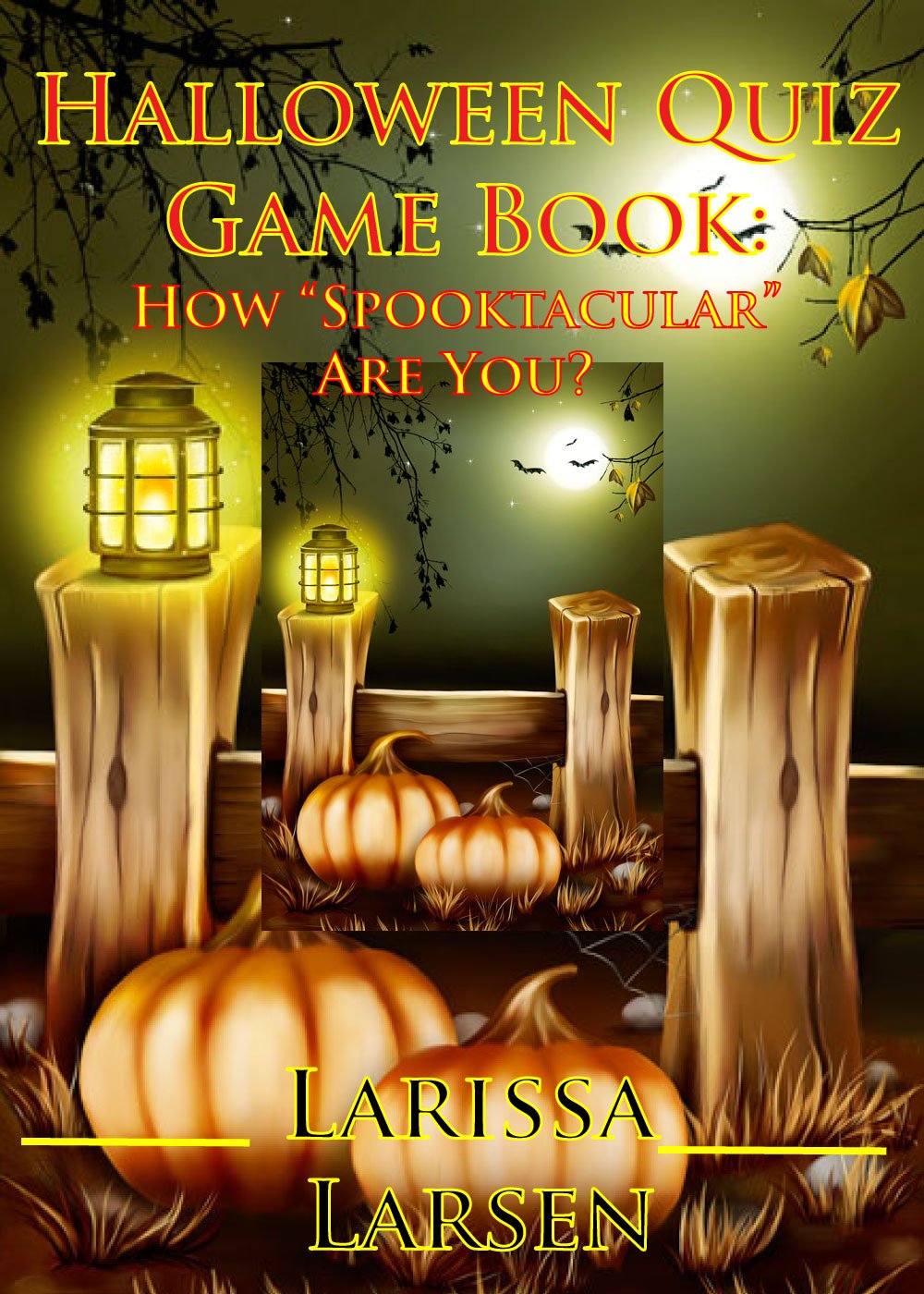
Review: Halloween Quiz Game Book: How Spooktacular Are You? by Larissa Larsen

Today's review is for Halloween Quiz Game Book: How Spooktacular Are You?

Up until now, I had only read what I would call "regular" ebooks. This one is different. The format is fun (albeit sometimes a tad confusing) as you jump from one link to another answering different Halloween-related questions. Keep track of how many you answer correctly on the first try! Once you reach the end, you can see how well you did (I'm a "Spookcatular Expert", hehe). Great big images accompany the questions, and because I was reading on my computer's Cloud Reader (I don't actually own a Kindle), a lot of the text was left hanging so sometimes I encountered just one line or one word alone on a page. I suppose that with an actual Kindle that does not happen, since the screens are quite different.

There are many questions, all related to Halloween or typical Halloween creatures such as Frankenstein's monster. This is great for the kids, and also for anyone looking to pass a pleasant time while discovering neat tidbits about this holiday. I especially liked the explanation about the meaning of the witches' cauldron (I didn't know that one!).

That being said, I personally would have preferred longer answers for most of the questions. For example, there is a question regarding Jack-o'-Lanterns, and I feel the answer held missed potential for a nice story regarding the origin of the term, and why pumpkins are used now instead of the original "lanterns" (do you know what they were?). Luckily, I was pleasantly surprised when, at the end of the quiz, I discovered a few pages with historical and fun facts such as the origin of Halloween, "souling," and many others explained in a clear and easy way.

Also at the back of the book, the author suggests some community-friendly Halloween activities, and offers several links to a selection of further holiday reading.

Overall, I would recommend this quick and interactive read to families and teachers. I can imagine using this with my ESL students, or using it with small children. The images are well-chosen and you can complete the entire quiz and the final information in around forty minutes.

For its quirky genre, I would give it a 4 over 5.

Monday, October 14, 2013

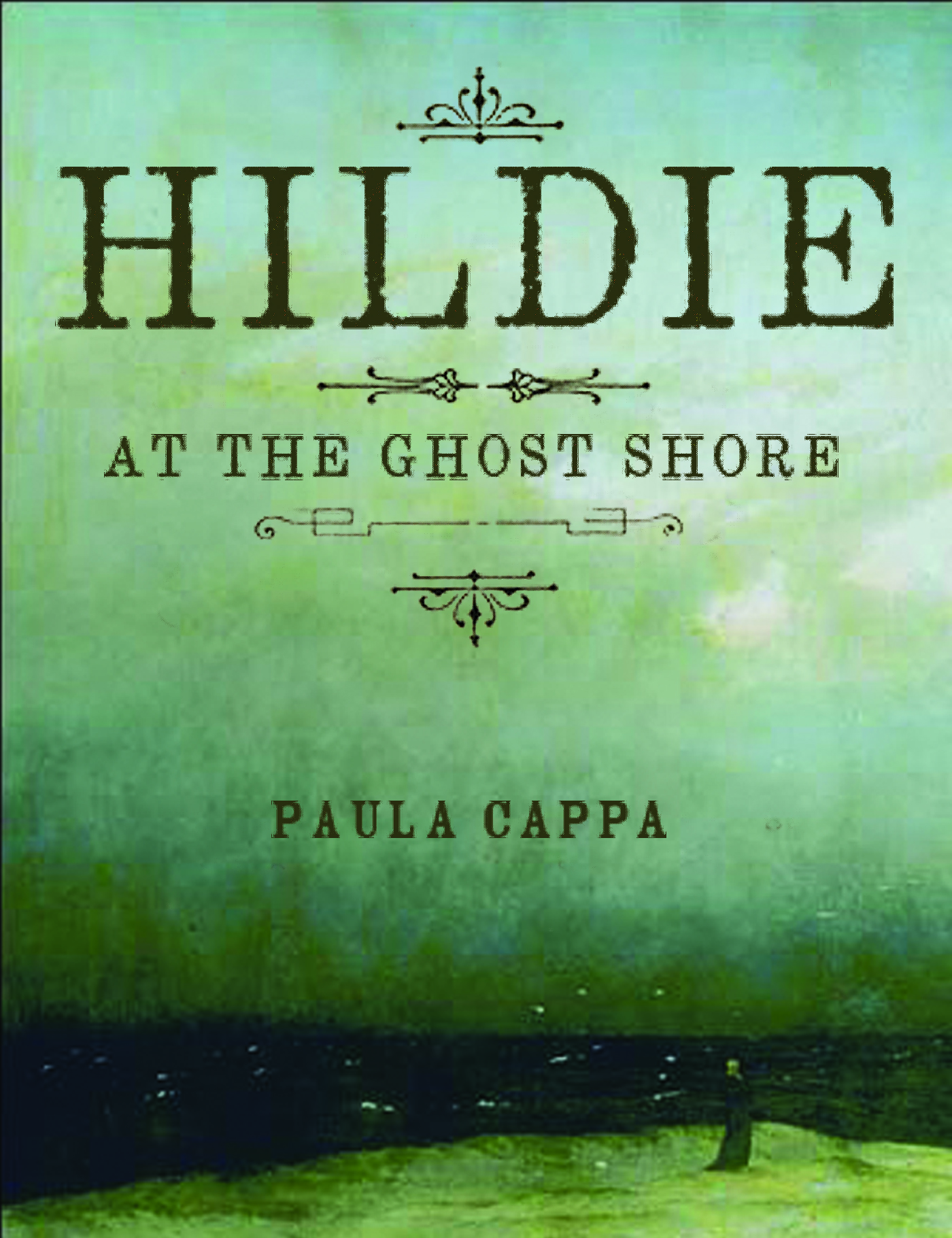
Review: Hildie at the Ghost Shore by Paula Cappa

Today I have the pleasure of reviewing the short story Hildie at the Ghost Shore by Paula Cappa. This short was previously published in the magazine Fiction365, and now you can download it for free in your preferred format from Smashwords.

Cappa combines magical storytelling with historical and supernatural elements to show you the story of rune-reader Hildie as she reads the fortune of a mysterious visitor.

The tale of Hildie at the Ghost Shore is revealed to readers at a leisurely pace, laced with evocative descriptions of the heroine's surroundings. While the start is somewhat slow for a 2,000-word story, it allows you to feel the magic surrounding Hildie and her little corner overlooking the Ghost Shore.

The most positive aspects of the short are the writing itself (completely error-free, something I truly value), and the author's knack for drawing the reader in to a world of Norse mythology. The ending is also thought-provoking and I would definitely like to see the story continue from there.

The main thing I missed here was a bit more action throughout. As I mentioned above, the pace is leisurely, and while I am more drawn to action and high-risk scenes, the slowness of Hildie at the Ghost Shore lets you feel the characters and, most of all, the setting. After reading, I feel it is probably the best way to tell this story, as Cappa gently takes you by the hand and draws you in to her imagination.

Overall, I would give Hildie at the Ghost shore a 3.5 over 5. While not precisely my cup of tea, I can still admire Cappa's storytelling capabilities. I would recommend this story to anyone interested in Norse mythology, runes, and, as the story's description states, "quiet little mysteries." While reading, it somehow reminded me of Edgar Allan Poe's A Descent into the Maelstrom.

Monday, February 25, 2013

Books for Writers # 5: Starve Better, review by Steven Young

Today's post is a book recommendation for all us writers, by fellow CCer Steven Young. He grew up in a village you've never heard of, but currently calls South London home. A marine biologist of sorts, he works at sea out of exotic locations like Singapore, Antarctica and North Yorkshire. With a single fluke short story sale, he is not yet a writer (or that's what he'd want us to believe...), but day by day, he learns.

You can find Steven on Critique Circle, along with the rest of us. Take it away, Steven!

When I discovered Starve Better: Surviving the Endless Horror of the Writing Life by Nick Mamatas, my head was spinning. I’d devoured all the how-to books and blogs I could find. And suddenly- oh my!- there were all these rules I had to follow! “Never use adverbs,” I was confidently informed. “Said-bookisms are a bad idea,” another source snarled. “Your writing will be ruined by passive voice,” said yet another. I felt paralysed, as though my mind was being poisoned by advice-overload. When I saw the opening chapter, “All Advice is Terrible Advice, Plus Other Useful Advice,” I knew I’d found my antidote.

After listing a bunch of, often contradictory, rules (“don’t be a pretentious Little Miss Fancy Britches. Make your prose purple and poetic,”) the author proceeds to debunk the very notion; pointing out that there “are no rules. Only the results matter.” The Harry Potter books, for example, are infamously littered with adverbs, and at least a few people seem to like them.

Before going further into his critique of traditional writing wisdom, the author detours briefly to highlight one recurring focus of the book worth emphasising here. He is primarily a short fiction writer, and much of what is said stems from that. This section is interesting in itself, going into the reasons why someone would write short fiction; for all that it is so uncommercial. And the reasons why someone should not write short fiction made me reassess some of my own assumptions. Turns out, it is neither easier than writing a novel, nor good practice for doing so.

The author goes on to discuss various structural elements of storytelling. One chapter discusses the importance of choosing a focus for the story, for a writer to capitalise on their strengths and downplay their weaknesses. Not every author can be a master of the intricate plot. Not every writer can break the reader’s heart with their characters’ plight. Work out what you are good at. Do it.

Something currently close to my heart is that dread beast- The Hook (Quick! Read the first sentence of this post again. Did it draw you in? If you’ve gotten this far, hopefully so. But believe me, I fretted about it.) The author has issues with the phrase ‘start with a hook.’ He considers the hook the “motor of the story.” It can be many things, from an unexpected plot twist to the quality of the writing itself, and can be found at any point in the story. Too often, ‘start with a hook’ leads a writer to include whizz-bang excitement in the first paragraph, followed by pages of irrelevance. No. The important thing is to begin the story at the place when the story actually starts. The purpose of the beginning is to show the reader that the writer knows what they are doing.


Via analysis of the role of the sentence in writing (including several pages rhapsodising about two sentences from a story by Raymond Chandler) and advice on writing dialogue (listen) he gets to an interesting discussion about how to end stories. Specifically, he suggests writers avoid neat, everything-is-resolved endings, to “leave room for that post-reading daydream”.

The part of the book dealing with the writing process itself ends with perhaps the most important question. “Why Bother?” Why deal with rejection after rejection, instead of self-publishing immediately. Reputation, essentially. Whilst I’m not sure I agree with his claim that being “not terrible” is sufficient for publication (as I think back to my own rejections, I certainly don’t want to agree), I can’t help but see publication as a kind of ‘proving ground’ for new authors.

The second half of the book shifts emphasis towards the nitty-gritty of getting cash for words. The focus is very much on non-fiction. The chapter on publishing non-fiction includes some eye-openers. I had no idea how much better paid non-fiction can be compared to fiction! He takes the reader through the process of finding and soliciting markets, and highlights the differences from fiction- work your way up, not down, and don’t bother trying to find market listings and submission guidelines.

The author also mentions writing for non-publication. Remember, this is all about fast money, not getting a six-figure advance and the Pushcart Prize. As he describes gigs from writing business letters to church newsletters, he gives the impression of being bloodhound of writing, forever sniffing around for the next easy dollar.

Considerable space is devoted to content mills and his time ghost writing term papers for students. Content mills seem to be the sweatshops of the writing world, with writers churning out online fluff for a pittance. There are perhaps ethical concerns regarding the ghost writing but I’m reviewing the author’s book, not his moral code, so whatever your stance, he highlights yet another way of getting paid to write.

This book may not be for everyone. It looks at the world of professional writing with a cynical eye. It may poke holes in fondly held preconceptions about writing, but does so with a distinctive acerbic wit. Despite being the very definition of the “barely published neophyte writer” whom the author disparages, and despite all advice being terrible, here’s some advice. If you are open to a perspective that differs from the norm, if you want to know more about life in the writing trenches, if you want to be entertained, read this book.


Thank you for your review, Steven. It's been great having you here!
Related Posts Plugin for WordPress, Blogger...