
Showing posts with label Bad Book Review. Show all posts

Thursday, May 12, 2016

Nostalgia Reading - R.L. Stine

Raise your hand if you also loved R.L. Stine as a kid!

I grew up reading Goosebumps and enjoying every moment of it! I remember going to the bookstore every month, bubbling with excitement, ready to get the latest book in the series.


Right now, I'm not sure which Goosebumps book I read first of all. I think it was The Ghost Next Door. It was the tenth book in the series, released in August 1993. From there, I went back through the list and read Say Cheese and Die! and Let's Get Invisible! and all the others.

I was hooked! I couldn't wait for the next book to come out--and they usually came out once a month or once every two months.

Shortly after turning ten, my love affair with Goosebumps guttered out.

The last Goosebumps book I read was The Scarecrow Walks at Midnight. It was released in May 1994. I still remember that day: I'd just bought the book and was at my aunt Delia's house. I sat on the big armchair in her living room and read the entire thing in about thirty minutes. Then I remember closing it and deciding that Goosebumps wasn't for me anymore.

I didn't stop reading just because of that book, though. The previous one, Deep Trouble, also wasn't all that I was expecting. The book prior to that one, Monster Blood II, involved something with a giant monster hamster... The previous one was called Why I'm Afraid of Bees. The cover showed a bee with the face of a boy... and I just wasn't feeling the love anymore. I think I actually skipped the bee one because the cover looked too silly. I was growing out of my Goosebumps phase and The Scarecrow Walks at Midnight marked the end.

Now that I think about it, I have such a strong sense of nostalgia towards these books, but if I do the math (August 1993 to May 1994), I was hooked on them for under a year! Even so, I must have read around 18 or 19 of them in total (the scarecrow one was number twenty).

I currently don't have all of the Goosebumps books I owned, but I still have most of them. I think I got rid of the ones I thought were too silly in a yard sale.

Around the time I was weaning myself off of Goosebumps, I discovered the Fear Street Saga, a trilogy set in different time periods, and I also immensely enjoyed it. The first book came out in 1993, so I must have been around nine when I began reading them.

Much darker than Goosebumps, the Fear Street Saga is a story of love, betrayal and revenge. I felt so grown-up reading it! I still have the trilogy, so last year I decided to give it a read and it holds up pretty well. The scenes aren't as vivid as I imagined them and the action seems rushed now, but I can still see the appeal.



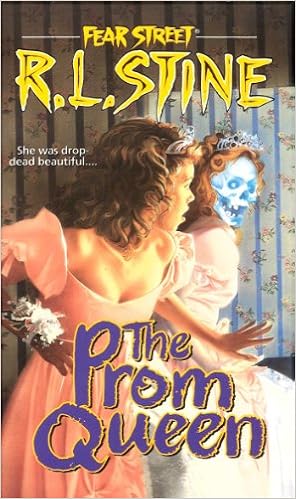
One of the last R.L. Stine books I read was The Prom Queen. I still have it so I should probably give it another read, but I remember I didn't like it all that much. I think I had matured too much by then and was looking for stronger stuff.

I think that around age ten I moved on to things like Lois Duncan's Down a Dark Hall or Daughters of Eve (I don't remember much about that second one, but I immensely enjoyed the first one), or Tad Williams' Tailchaser's Song.

I still don't know how my parents just let me get any book I wanted! Tailchaser's Song was not intended for a ten-year-old audience! But still, it's wonderful.


And now we come to present-day me, thirty-two years old and browsing through a used book store. I came across Call Waiting by R.L. Stine and immediately bought it just to have a nostalgic kick. I'd never read this one before, but I wanted to see if my favorite childhood author still lived up to my expectations.

Nope!


I'm not going to criticize the style or the simplicity (or the predictability) of the novel because I'm not its intended audience, but I will criticize one thing: sexism.

The main character is a teenage girl called Karen. We don't really get to know her except for one thing: she has a boyfriend who she's terrified of losing. Her whole life revolves around her boyfriend and her suspicions of him cheating on her with someone else. Her thoughts and her conversations are centered on her boyfriend during the entire book. We don't really get to know anything about her, no hobbies or areas of interest.

Is the guy worth all that? All we know is that he has long dark hair and that's supposed to be very sexy. He barely interacts with Karen, and when he does, he comes off as aloof and not very interested in their relationship.

Overall, Karen came off as the typical "psycho girlfriend." That's just sad. The final straw came when readers discover the "phone killer" who had made the threatening calls was another teenage girl also after the boy.

The whole story boils down to two women fighting for a man.

It's not like this sort of situation can't actually happen, but an entire book portraying teenage girls as completely dependent on boys and void of any hobby or interest other than having a boyfriend just makes me think this isn't the best kind of role model you want to give your kids.

Am I reading too much into this? Children are incredibly perceptive but they might not be able to discern good role models from bad role models. Furthermore, I believe readers usually try to identify with the main character of a novel. Is a one-dimensional and dependent main character a good example for young readers?

Tuesday, February 23, 2016

Review - The Boy in the Striped Pajamas

Well, my 2015 Reading Resolution was a huge bust. I managed to read all 18 Fullmetal Alchemist books, but not many others from my list... *Sigh.*

The year 2016 started off on the right foot. All the wedding preparations are behind me, so that takes a lot of pressure off my back!

Okay, I just said this year started off well, but the truth is the very first book I read in 2016 made me furious. And not because of the harrowing subject matter itself (the Holocaust), but because of how the author disrespected this subject and...well... any reader's intelligence.

The first book I read in 2016 was The Boy in the Striped Pajamas by John Boyne.

**This review contains SPOILERS.**

I've had this book on my "to-read" list for a long time, so when I recently saw it in the bookstore I thought "what the heck." After reading it, I can't fathom how so many people call it a masterpiece.

For starters, the children in the book read more as around six and eight years old instead of the supposed nine and twelve. Bruno, the German main character, is so naive that one cannot help but wonder if he suffers from some sort of mental retardation. I'm not saying this out of malice; I truly wondered if the author meant to portray him as a child with mental difficulties. I suppose the author wanted to show innocence and lack of malice, but it quickly became irritating and patronizing to children. Children aged nine are simply not as oblivious to the world around them as Bruno, and the way the author depicts children makes me think he doesn't have a very high opinion of them in general.

Moreover, with Bruno being the child of a German commandant in charge of Auschwitz, he should know basic concepts such as "Jew" or "Heil Hitler." Instead, he seems oblivious to absolutely everything. I would expect a German child--son of a commandant no less!--to receive a strict fascist education from the get-go. Perhaps already be a part of the Hitler Youth Groups. Instead, all this is overlooked and Bruno doesn't even know the meaning of "Heil" or who "this Hitler man" is.

Another downside in the book was the multiple play on words which only work in English, even though the characters are supposed to be speaking German. Bruno's use of "Out With" instead of Auschwitz gets old very fast, as well as the use of "Fury" for Führer. These mistakes just don't work because these words are completely different in German so the play on words only makes sense for English speakers. Even so, they're hammered in throughout the book and Bruno even has whole conversations about how he mistakes words--conversations about mistakes that are actually impossible for him to make!

Finally, the last straw for me was when Bruno mistakes the prisoners of Auschwitz for holiday-goers. I couldn't believe what I was reading. I kid you not: Bruno believes the people inside the metal fences aren't doing anything because they're "on holiday." The author, in my opinion, has gone too far. No child aged nine is so self-centered, blind and unobservant. Any child living in those extreme surroundings would be awake enough to know something isn't right. Sadly, this isn't the case for our dear Bruno.

The final pages of the book have been described as a "whirlwind." I feel (just a bit) like a horrible person for saying this, but the moment Bruno decided to cross the fence into the concentration camp, I was looking forward to his death. Even that fell flat. None of the characters were engaging and the piece ended up centered around an annoying boy living his oblivious privileged life until the final paragraphs, where we began to see some of the horrors the prisoners endured. But even then, everything was from Bruno's blundering point of view, and that felt immensely disrespectful to the true victims of the story.

In conclusion, The Boy in the Striped Pajamas felt like a mockery. The arguments "it's from a kid's point of view" and "it's meant to be a fable" are irrelevant to me. I found it offensive and distasteful on so many levels, starting with the way it misrepresents children to the way it skims over the victims of the concentration camp--don't forget that the second main character is a child living inside the concentration camp (a small child who, by the way, would have most probably been sent to the gas chamber during his first month there).

If you're interested in Holocaust stories, do yourself a favor. Skip The Boy in the Striped Pajamas and head straight for a true story, a Pulitzer winner, a masterpiece: Maus by Art Spiegelman.


The Boy in the Striped Pajamas frustrated and outraged me so much that I'm going to give it zero Pirates, which is really a shame because just look at that cute widdle face!


Sunday, March 15, 2015

2015 RR - The Vision by Dean Koontz

I'm no Dean Koontz fan, but I somehow ended up with four or five of his novels in my home library. The third book I tackled for my 2015 Reading Resolution is The Vision. For the life of me, I couldn't find an online image of the edition I have (a 1987 reprint), so I took a picture myself.

What can I say about this book? Hmmm... Uh... It reads quickly? I actually abandoned it several years ago due to the painful dialogues, and only read it now to complete my resolution. Needless to say, I didn't enjoy it.

Plot

Mary, best-selling author who lives with her new husband Max in Bel Air, is a clairvoyant who visualizes murders before (and sometimes while) they occur. She helps police intercept the killers before they can continue their rampage. However, one day Mary's visions change: she can feel the pain of the victims and she fears for her life. It seems the murderer knows she's observing him, and is after her.

Pros

A quick, effortless read.

Cons

There are so, so many things I didn't enjoy about this book. For the sake of brevity, I'll give you a list of my top peeves.

1) The story itself it crammed with clichés up until the final showdown with the villain, who (of course) takes the time to give a fully detailed recount of all his antics and motives before swooping in for the final kill.

2) The characters feel like paper cutouts and constantly share "as you know, Bob" conversations. It's ridiculous to read page after page of characters explaining things to each other--things they both already know! There has to be a more elegant way to transmit back story. I'd prefer a simple narrative paragraph every now and then instead of having the characters talk to each other like they're all going through acute bouts of amnesia.

3) The writing style itself is sometimes irritating. In this novel, Koontz seems to have developed some sort of allergy to conjunctions. What happened to the humble "and"? Gone. Here are some examples:

     - He sat up, switched on the lamp, looked around the room.
     - He let go of her wrist, pushed his hair back from his forehead.
     - At last the intense, dark-skinned young man stood up, helped the blonde to her feet.

I wouldn't mind if these parallel structures appeared every now and then, but here we're talking about page after page.

4) Another problem I have is the amount of scene breaks. The novel feels like it was written for a TV drama. We get two paragraphs, scene break, two more paragraphs with the same character five minutes later, scene break. Is it really necessary to cut scenes every time a minute goes by? Where's the flow? Just have a look at page 189 of my edition:

  7:00 P.M.
     Mary squeezed Max's hand and waited tersely. Any minute the walkie-talkie would crackle with a report from one of the deputies. [One more longish sentence.]
  7:03.
     Mary repeatedly glanced at her watch in the back glow of the police cruiser's headlights. She shifted restlessly from one foot to the other.
  7:04.
     For the first time in more than an hour, Chief Patmore looked at her, met her eyes. He wasn't happy.
  7:06.
     She was beginning to feel that she had been outmanoeuvred, outwitted. [Two more sentences.]
  7:09.
     She was numb with fear. "Something's wrong," she said.
     "What is it?" Max asked.
     [Scene continues for a very brief conversation and then we cut again to 7:30.]

In this case, the cuts are meant to increase tension, but come on. I just--I just can't. No. Really. I can't.

5) The author attempts to slip the reader a big fat red herring, but in my opinion fails miserably. So much attention is drawn to a single character in an attempt to make the reader think he's the culprit, that it quickly becomes uncomfortable and embarrassing.

The Vision is one of Koontz's earlier works--but not his first. Have another look at that cover. Yeah, it boasts he's the author of Strangers and Darkness Comes. Inside the book, we have a list with a total of seven Koontz titles. So, The Vision might be an early Koontz novel, but with seven others under his belt, I would hardly call it the work of an amateur.


*Sigh*

I'm not a big fan of giving bad reviews, but I can't lie, either. At least it's a quick, mindless read.


Bonus rant round!

Take a load of this conversation from page 20:

     "What a mayor you are," [Harry Oberlander] said with heavy sarcasm. "Hiring a witch to do police work."
     Henderson responded like a weary giant spotting yet one more tiny challenger with delusions of grandeur. "She's not a witch."
     "Don't you know there's no such thing as a witch?"
   
What did I just read? Oberlander accuses Henderson of hiring a witch. Henderson responds that she isn't a witch. Oberlander reminds Henderson that witches don't exist. Then why does he even accuse Henderson of hiring a witch in the first place?


Final round: The Longest Sentence in the History of Sentences

I'm not saying this sentence is bad. It does its task perfectly and really sets the scene. Do you want to read it? Do you? It contains spoilers, so only proceed if you dare.

Pages 244-245:

     Even before he completed the thought, the knife ripped into him, rammed out of darkness and into him, felt like the blade of a shovel, enormous, devastating, so devastating that he dropped the gun, feeling pain like nothing he'd ever known, and he realised that the killer had pitched the flashlight aside as a diversion, hadn't really been hit at all, and the knife was withdrawn from him, and then shoved hard into him again, deep into his stomach, and he thought of Mary and his love for Mary and about how he was letting her down, and he grappled with the killer's head in the dark, got handfuls of short hair, but the bandage came off his finger and the cut was wrenched open again and he felt that pain separate from all the others and he cursed the sharp edge on the car's jack, and the flashlight his the floor ten feet away, spun around, cast lunatic shadows, and the knife ripped loose from him again, and he reached for the hand that held it, but he missed, and the blade got him a third time, explosive pain, and he staggered back, the man all over him, the blade plunging again, high this time, into his chest, and he realised that the only way he could hope to survive now was to play dead, so he fell, fell hard, and the man stumbled over him, and he heard the man's rapid breathing, and he lay very still, and the man went for the flashlight and came back and looked down at him, stood over him, kicked him in the ribs, and he wanted to cry out but didn't, didn't move and didn't breathe, even though he was screaming inside for breath, so the man turned away and went towards the arch, and then there were footsteps on the tower stairs, and, hearing them, he felt like such a useless ass, outsmarted, and he knew he wasn't going to be able to recover his gun and climb those stairs and rescue Mary because stuff like that was for the movies, pain was pulverizing him, he was leaking all over the floor, dripping like a squeezed fruit, but he told himself he had to try to help her and that he wasn't going to die, wasn't going to die, wasn't going to die, even though that was exactly what he seemed to be doing.

And that's it for The Vision! I haven't had much time to post on the blog recently, but I have had time to read. I just finished the fourth book in my 2015 Reading Resolution list: The Princess Bride. Well...I finished the main story but still had to read the epilogue of sorts, and then my cat puked on the book so now I'm not sure if I actually got the nerve to finish those last pages...

Friday, November 21, 2014

Review - The One-Hundred-Year-Old Man Who Climbed Out the Window and Disappeared

A good book stays with you forever. Unfortunately, sometimes bad books linger in your unconscious as well.

Today I would like to write a review on the book The One-Hundred-Year-Old Man Who Climbed Out the Window and Disappeared (dare ya' to say that five times real fast!). I had been wanting to read it for quite a while, but when I finally got my own copy... You guessed it: me no likey. Of course, what I express here is nothing more than my personal opinions and frustrations.

Have any of you read this novel? Were you able to finish it? Did you enjoy it? My responses to these questions are: I tried. No. Sort of.

What does the novel have to offer? An interesting premise: On his one-hundredth birthday, Allan Karlsson decides he's had enough of the old people's home he's in and he does just what the title promises--he jumps out the window and (as far as the authorities know) disappears. From here on, he initiates a wild adventure that will, among other things, team him up with an elephant and make him a rich man. As the story progresses, we also learn about his past as an explosives expert, a profession which took him all across the world.


Sounds interesting, doesn't it?

It would be, if the author hadn't gone out of his way to make it BORING.

Let me explain. The novel starts out all right. Karlsson escapes from the old people's home (it's always called just that: "the old people's home." No specific name, no nothing.) and makes his way to the bus station where he encounters a disgruntled youth with bathroom and suitcase problems. In the end, Karlsson gets on a long-distance bus with the young man's suitcase (he just goes ahead and steals it). What's inside? The equivalent to hundreds of thousands of dollars. What happens next is what you'd expect from any centenarian with nothing to lose:


a cold-blooded killing spree.


(And he doesn't even have a shred of guilt about any one of the deaths. Wanna know why? Because good ol' Allan Karlsson is a freaking psychopath!)

Now, I'm not a prude. I've read my share of adventure, sci-fi and fantasy in which blood is poured over several pages. However, what startles me about The One-Hundred-Year-Old Man is:

1) The deaths are obviously meant to be the humorous parts of the story.
2) None of the characters--not Karlsson, not even the other people who eventually team up with him--seem to care the slightest that they are terminating human lives.

Now, you might shake your head and say "But Nadine, get your adjectives straight! You said the story was boring! What's boring about this?" Let me explain: the author apparently does everything he can to make the would-be adventure/killing spree dull.

Would you like an example? The vast majority of the story is told in reported speech:

     They had a late evening at Bellringer Farm with one and all in very good spirits. Amusing stories were trotted out one after the other. Bosse was a hit when he pulled out the Bible and said that now he would tell them the story of how he, quite involuntaringly, came to read the whole book from beginning to end. Allan wondered what devilish method of torture Bosse had suffered, but that wasn't what lay behind it. No outsider had forced Bosse to do anything, No, [sic] Bosse's own curiosity was responsible .
     -- I'm sure I'll never be that curious, said Allan.
     Julius asked whether Allan could stop interrupting Bosse for once so that they could hear the story, and Allan said he could.

This is a typical sequence taken straight out of the novel (page 237 of my edition--cover image above). The problem with using so much reported speech is that readers can't really get a sense of the characters because we can't hear them. We only hear the narrator--whoever that is--explain a story to us.

There are some rare instances where we readers can delight in morsels of direct speech, but the author can't even get that right... Now, this might actually be a translation error, but the dialogue starts off between quotation marks, and then suddenly shifts to em dashes (the same way dialogue is represented in Spanish). Why the sudden change in punctuation? Where's the sense in that?

If the use and abuse of reported speech weren't enough, the author rams certain character details down our throats so many times that "repetitive" becomes an understatement (Karlsson like to drink, Karlsson doesn't care about politics, Karlsson has no sex drive--I get it already! No need to hammer in the character profile every dozen pages!)

The One-Hundred-Year-Old Man has been compared to Forrest Gump in that the character blithely meets the most important political figures of his era and he's oblivious to the significance of the meetings (because he's not interested in politics! Haha! Do you see the hilarity of it all? Do you? ...You don't? Oh.). However, while Forrest Gump is endearing, Allan Karlsson is a self-centered scoundrel. One thing is for Karlsson to have no interest in religion or politics (the author repeatedly informs us of this--several times in each chapter--in case we ever happen to forget), but it's another thing altogether when that character demonstrates alarming sociopathic tendencies. Once again, let me give you an example:

Karlsson is the type of man who spends months (if not years--my memory fails me now) travelling across the Himalayas with a small group, sharing their food, drink and adventures. He is the type of man who befriends these people and goes on about how he loves them. He is also the type of man who stands by and watches as his friends each take a bullet to the brain and then reacts with a curious "I wonder why my friends always end up dying?" To my disgust, he is also the type of man who then shrugs off all love for his deceased companions and proceeds to make friends with the killers--for his own greedy needy benefit, of course.


I hate Allan Karlsson!

This novel has been sold to us as a heartwarming tale. It has even become a full-length motion picture... But heartwarming it is not. To me, it is the story of a man who doesn't care about anyone other than himself. A man who demands a glass of vodka every two or three pages (and that's supposed to be a "ha ha" moment. "Ha ha! A Swede drinking vodka! Brilliant!"). A man who, the way I see it, has lived much longer than he deserved. Couple that with the repetitive reported speech writing style and you've got a pretty nifty paperweight.

I must admit that so far I haven't been able to finish the novel (I'm a little more than halfway through). Even so, I felt the need to express my frustration in a review. I'll try to complete the novel someday, but I won't make any promises.

What about you? Have you read this novel? If so, what is your opinion?
Related Posts Plugin for WordPress, Blogger...