Showing posts with label On Reading. Show all posts

Thursday, June 2, 2016

Fullmetal Alchemist - My Favorite Manga

During Christmas 2014, I made a trip to my closest FNAC to buy my husband a few Wolverine comic books, and I happened to discover a little something that stole my heart.

Fullmetal Alchemist is the story of brothers Edward and Alphonse Elric, who try to resurrect their mother using alchemy. The process fails, and Edward loses his leg whereas his younger brother Alphonse vanishes. In a desperate attempt to save his only remaining family, Edward sacrifices his arm and traps his brother's soul inside a suit of armor. Now the two embark on a quest to find the Philosopher's Stone to use its powers to recover their bodies.

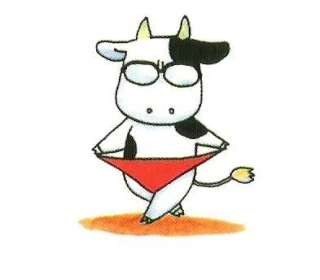
Arakawa grew up on a dairy farm,
and always portrays herself as a cow.

Written and illustrated by Hiromu Arakawa, Fullmetal Alchemist thrives on strong characters, be they male, female or androgynous (the character Envy. What the heck is he/she/it?). For me, characterization is one of the strongest points in the story. We are presented to many people (think Game of Thrones amount of people...), and we have many women--something I appreciated.

Arakawa doesn't hesitate when it comes to blood, death and disfigurement. No one is safe in Amestris, and not just that, but Arakawa manages to make you care for each and every one of them. The Elric brothers, Edward and Alphonse, make a sympathetic duo from the get-go, and all the supporting characters (especially Roy Mustang and Riza Hawkeye) have their own intricate backstories as well as their own place in the story.

The adventure begins innocently enough, and the first few adventures are lighthearted--up until we learn about human chimeras. Soon the pieces of a much darker story fall into place and the characters discover they've been pulled into the heart of a nationwide menace. The story actually goes beyond the mere adventure, and brings forth questions on the meaning of God, "Truth" and the universe.

(Read from right to left.)

There has been quite a lot of talk about the religious message embedded in Fullmetal Alchemist. From posts which claim the manga is about Buddhism, to posts which claim that the manga has both a negative and positive message on religion. I tend to agree more with the mixture of positive and negative messages, as absolutely nothing is black or white in Fullmetal Alcehmist (and that's what I love about it).

Talking about black or white, Arakawa includes several intriguing villains, based on the names of the seven deadly sins. At certain points, readers actually care for the so-called villains, feel sympathy towards them, and hope they have a happy ending. But alas, we can't have it all!

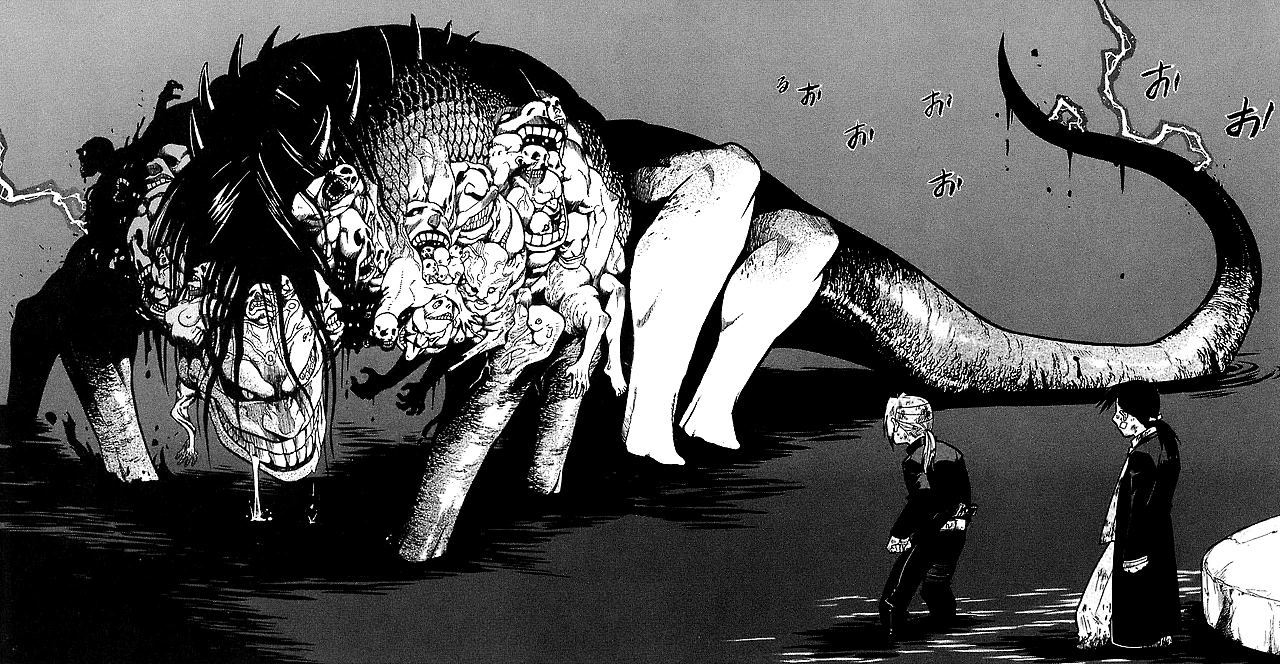
The villain Envy transforms into a grotesque creature bubbling with
the faces of the innocent souls trapped in its body.

Overall, Fullmetal Alchemist grabbed me with its open-to-interpretation philosophical viewpoint, its rich story colored with tones of grey, and its sympathetic characters. I have the Kanzenban edition, comprised of eighteen colorful volumes. I strongly recommend it to anyone with an urge to take a peek at manga. You'll soon discover why it's become an instant classic.


Thursday, May 12, 2016

Nostalgia Reading - R.L. Stine

Raise your hand if you also loved R.L. Stine as a kid!

I grew up reading Goosebumps and enjoying every moment of it! I remember going to the bookstore every month, bubbling with excitement, ready to get the latest book in the series.


Right now, I'm not sure which Goosebumps book I read first of all. I think it was The Ghost Next Door. It was the tenth book in the series, released in August 1993. From there, I went back through the list and read Say Cheese and Die! and Let's Get Invisible! and all the others.

I was hooked! I couldn't wait for the next book to come out--and they usually came out once a month or once every two months.

Shortly after turning ten, my love affair with Goosebumps guttered out.

The last Goosebumps book I read was The Scarecrow Walks at Midnight. It was released in May 1994. I still remember that day: I'd just bought the book and was at my aunt Delia's house. I sat on the big armchair in her living room and read the entire thing in about thirty minutes. Then I remember closing it and deciding that Goosebumps wasn't for me anymore.

I didn't stop reading just because of that book, though. The previous one, Deep Trouble, also wasn't all that I was expecting. The book prior to that one, Monster Blood II, involved something with a giant monster hamster... The previous one was called Why I'm Afraid of Bees. The cover showed a bee with the face of a boy... and I just wasn't feeling the love anymore. I think I actually skipped the bee one because the cover looked too silly. I was growing out of my Goosebumps phase and The Scarecrow Walks at Midnight marked the end.

Now that I think about it, I have such a strong sense of nostalgia towards these books, but if I do the math (August 1993 to May 1994), I was hooked on them for under a year! Even so, I must have read around 18 or 19 of them in total (the scarecrow one was number twenty).

I currently don't have all of the Goosebumps books I owned, but I still have most of them. I think I got rid of the ones I thought were too silly in a yard sale.

Around the time I was weaning myself off of Goosebumps, I discovered the Fear Street Saga, a trilogy set in different time periods, and I also immensely enjoyed it. The first book came out in 1993, so I must have been around nine when I began reading them.

Much darker than Goosebumps, the Fear Street Saga is a story of love, betrayal and revenge. I felt so grown-up reading it! I still have the trilogy, so last year I decided to give it a read and it holds up pretty well. The scenes aren't as vivid as I imagined them and the action seems rushed now, but I can still see the appeal.


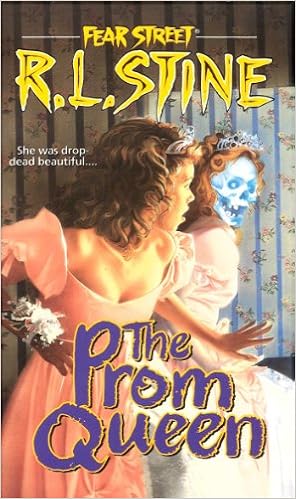
One of the last R.L. Stine books I read was The Prom Queen. I still have it so I should probably give it another read, but I remember I didn't like it all that much. I think I had matured too much by then and was looking for stronger stuff.


I think that around age ten I moved on to things like Lois Duncan's Down a Dark Hall or Daughters of Eve (I don't remember much about that second one, but I immensely enjoyed the first one), or Tad Williams' Tailchaser's Song.

I still don't know how my parents just let me get any book I wanted! Tailchaser's Song was not intended for a ten-year-old audience! But still, it's wonderful.


And now we come to present-day me, thirty-two years old and browsing through a used book store. I came across Call Waiting by R.L. Stine and immediately bought it just to have a nostalgic kick. I'd never read this one before, but I wanted to see if my favorite childhood author still lived up to my expectations.

Nope!


I'm not going to criticize the style or the simplicity (or the predictability) of the novel because I'm not its intended audience, but I will criticize one thing: sexism.

The main character is a teenage girl called Karen. We don't really get to know her except for one thing: she has a boyfriend who she's terrified of losing. Her whole life revolves around her boyfriend and her suspicions of him cheating on her with someone else. Her thoughts and her conversations are centered on her boyfriend during the entire book. We don't really get to know anything about her, no hobbies or areas of interest.

Is the guy worth all that? All we know is that he has long dark hair and that's supposed to be very sexy. He barely interacts with Karen, and when he does, he comes off as aloof and not very interested in their relationship.

Overall, Karen came off as the typical "psycho girlfriend." That's just sad. The final straw came when readers discover the "phone killer" who had made the threatening calls was another teenage girl also after the boy.

The whole story boils down to two women fighting for a man.

It's not like this sort of situation can't actually happen, but an entire book portraying teenage girls as completely dependent on boys and void of any hobby or interest other than having a boyfriend just makes me think this isn't the best kind of role model you want to give your kids.

Am I reading too much into this? Children are incredibly perceptive but they might not be able to discern good role models from bad role models. Furthermore, I believe readers usually try to identify with the main character of a novel. Is a one-dimensional and dependent main character a good example for young readers?

Tuesday, May 3, 2016

Review - Stardust

I saw the film Stardust many years ago on an overseas flight and immensely enjoyed it. The book, however...


**Warning! Spoilers for both the movie and the novel.**

Stardust was one of those movies I knew absolutely nothing about. I didn't know what to expect, and that was awesome. I remember the man sitting next to me on the plane was also watching it (his session was a bit ahead of mine) and he was literally laughing out loud, having the hardest time trying not to make too much noise.

Stardust is a fantasy adventure with magical and memorable characters: murderous princes, evil witches, a star fallen from the sky... and a regular love-stricken country boy, Tristran Thorn.

The story is basic: young Tristran promises to give Victoria, the woman he is infatuated with, a fallen star to prove his love. To find the fallen star, he must cross an age-old wall and search the magical land of Faerie. However, he doesn't know that other, much more dangerous, people are after the same star.

In my opinion, the movie greatly outdid the novel. The film adaptation was riveting, funny, quirky, full of memorable characters and beautiful landscapes. The novel, while it did have some positives, didn't feel as charming.

Where the film outdid the novel:

Overall, the tone of the film is much more enjoyable than the novel, at least in my opinion. Perhaps it's because I saw the film many years before reading the novel, and it already was one of my favorites. Also, the film seems to get more to the point. In the novel, it took Tristran a terribly long time to reach the star, Yvaine, and it's not a very long book. While reading, I kept worrying that I was about to reach a third of the book and he hadn't met Yvaine yet!

In both the novel and the film adaptation, Tristran and the fallen star, Yvaine, end up falling in love. They realize they're meant for each other, and Tristran abandons his quest to please the unattainable Victoria.

The love story between Tristran and Yvaine is dealt with nicely in the film. In their escape from danger, they board a sky ship high in the clouds. The captain befriends them and during their stay, we see the two characters interact and slowly fall for each other.

In the book, however, the two characters spend the vast majority of the time arguing or in a mood. Only near the end do they suddenly decide they should be together. It was a letdown and did not feel natural. Tristran treats Yvaine as an object during the majority of the book, and only realizes she has feelings and is in pain near the end. (Unlike the film, where the witch heals Yvaine's twisted ankle, in the novel Yvaine's leg is broken from her fall and she's in pain during most of the story. When her leg finally heals, she has limp.)

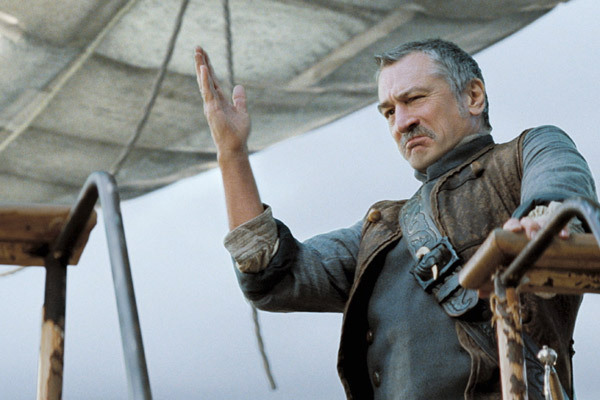
Now that I've mentioned the sky ship, I must also point out the captain, who in the film was called Captain Shakespeare (that was not his name in the novel). He was played by the impeccable Robert de Niro. For me, he is the most endearing, badass and whoopsie character in the entire film, so you can imagine the massive disappointment I was in for when I realized his persona didn't even exist in the novel. It was sad...

The ruthless prince Septimus was also much more charismatic in the film adaptation than in the novel--and he spoke, too! In the novel, he rarely speaks and is always--always--described as crowlike. Every time he appears on the page, expect to see crowlike lurking nearby. Unfortunately for him, Septimus dies both in the novel and in the film. The film had him dying in a magnificent final battle--which, to be honest, felt a bit over the top and Hollywoodish. His death in the novel was shockingly simple: he is bitten by a poisonous snake. I actually partly prefer the novel's way to off this character, because honestly, the film's final megabattle with the witches felt like too much.


Where the novel outdid the film:

The author isn't afraid to show blood and death if necessary. Both in the novel and the film, a unicorn is killed. In the novel, it is much more graphic and the witch later partially resurrects the unicorn for a ritual to find the star. That made for a highly interesting scene.

The film adaptation of Stardust portrayed Victoria, Tristran's initial love interest, as a superficial pretty girl and not much else. I was happy to see that she is a deeper character in the novel. She doesn't toy around with Tristran so maliciously, and she is in turmoil during the time Tristran disappears into the land of Faerie. Near the end of the novel, there is an excellent scene where Tristran returns to his hometown and discovers much more time has passed on that side of the wall than in Faerie. He meets with Victoria and she tells him how worried she was and how guilty she felt for making him walk into the magical land to find that fallen star.

Probably my favorite part about the novel, which I mentioned above, is that there isn't any big final battle between the heroes and the evil witches out to devour Yvaine's heart. That battle, while well-done, felt over the top, as if Hollywood can't fathom having an adventure without a fatal final showdown. In the novel, the main witch defeats herself with her own powers. Instead of having a final battle, the witch consumes all her powers in her search for Yvaine and becomes a frail creature, unable to do anything to acquire the star's heart. Yvaine ultimately takes pity on her.

Overall, in my opinion the film is much superior to the novel. I don't normally say this but good work, Hollywood! The main problem with the book is that I didn't feel I needed to go back to it. I didn't feel that invisible tug drawing me to its pages. While halfway through, I actually left it for over week and had to force myself to get back to it.

Stardust the film receives four Pirates!


Stardust the novel receives two and a half Pirates.

Tuesday, April 19, 2016

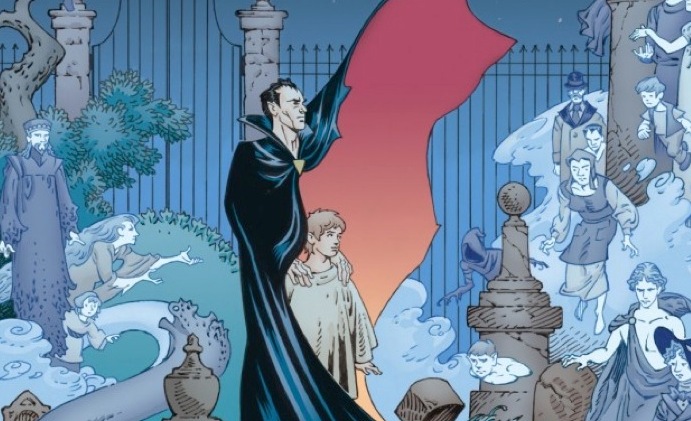
Review - The Graveyard Book

When I came across The Graveyard Book by Neil Gaiman it sounded so, so good! Just read this premise and tell me if it isn't right up my alley!

After the grisly murder of his entire family, a toddler wanders into a graveyard where the ghosts and other supernatural residents agree to raise him as one of their own.

This is a story about a boy raised by ghosts! Ghosts! It's The Jungle Book meets Casper! Right? Right?


I wanted to love this book--I really did. But I just couldn't. It's a shame because the dark topic interests me, and the characters were sympathetic. The main character Bod--short for Nobody--Owens is a smart and likable child and as a reader you really care for him. His undead guardian, Silas, is a delicious mystery who quietly dominates every page he's on.

I think my main issue with The Graveyard Book is that I expected a continuous story about how Bod Owens grows up amidst ghosts and other supernatural creatures. Instead, each chapter jumps ahead several years in his life. Each one reads as its own short story, a more or less closed off adventure, and that made the whole book feel disconnected. I know Gaiman was taking a The Jungle Book approach to this story, but it just didn't work for me.

I guess I should've known better, since I read Rudyard Kipling's The Jungle Book several times when I was a teen. Even so, I think The Graveyard Book initially promised something more linear due to how the story is presented in the first chapter: readers are given a terrible crime, a bloodthirsty villain, an innocent victim and a slew of ghosts to protect him. It felt like the perfect setup for one continuous adventure. Instead, we read one chapter focused on how he makes a living friend. Another focuses on how he is kidnapped by goblins. Another focuses on him going to school with the living... In the end, he always returns to the graveyard and to his dead companions, so each chapter has very little impact.

On a positive note, the best moments for me are, without a doubt, when Bod interacts with other living people. In those scenes, you can see how much of an impact life among the dead has had on the boy. The ghosts teach him certain otherworldly abilities, such as fading, and he uses these to his advantage when he's in danger. Perhaps my favorite story is when he attempts to go to a normal school (aka "for the living") and encounters a bully. The way Bod quietly solves his problems is admirable.

There are other bigger and much more dangerous problems Bod cannot solve on his own, and here his guardian Silas takes over--or others such as the witch Liza or the teacher Miss Lupescu.


However, I have a couple issues with this. At the beginning of the book, the ghosts Mr and Mrs Owens adopt Bod. The cemetery dwellers assign Silas as Bod's guardian because Silas is the only one who can step out into the human world (in order to bring Bod food, clothing, etc.). So what do the Owens do during the entire book? Not much, really. Except for the first chapter, they rarely appear, rarely interact with Bod, and are rarely mentioned. I ended up wondering if it wouldn't have been better to just ignore them and hand Bod over to Silas.

My second issue involving Bod's caretakers occurs near the end of the book. Silas and Miss Lupescu go on a quest to defeat the main evil-doers in the story. This part of the plot was so rushed and so glossed over that the significance of events was lost to me. In my opinion, the events involving these two characters--events which lead up to the final battle--could have been shown more clearly so as not to confuse readers.

The ending is highly predictable and the final battle is filled with clichés that I won't begin to list. Let me just point out that the worst cliché, in my opinion, is when the super villainous villain has the upper hand and is about to off our hero, but before going in for the fatal blow he decides to waste time revealing every single important plot point and evil plan to the hero who, once he has all the information, in one fell swoop vanquishes the evil-doer.


I really hate that cliché.

As with Coraline, also by Neil Gaiman, the ending to The Graveyard Book felt rushed in comparison to the rest of the book. I was expecting so much more. It physically pains me. This could have been so great. It had so much potential! Unfortunately, The Graveyard Book gets two and a half Pirates.


Thursday, April 14, 2016

Books I Love - I Am Legend by Richard Matheson

I Am Legend is one of my all-time favorite books. Key word: book. Forget about that movie. What movie? There wasn't any movie!

(Actually, this novel by Richard Matheson has not one, not two, but four film adaptations...)

Here is the book description from Goodreads:

Robert Neville is the last living man on Earth... but he is not alone. Every other man, woman and child on the planet has become a vampire, and they are hungry for Neville's blood.

By day he is the hunter, stalking the undead through the ruins of civilisation. By night, he barricades himself in his home and prays for the dawn.

How long can one man survive like this?

I Am Legend is the best vampire novel I have ever read (step aside Mr. Stoker!), and it's all due to the atmosphere. The author creates a suffocating environment charged with loss, guilt and helplessness, in which we follow Neville through his day-to-day repairing his home, scavenging for food, and hunting down and killing as many vampires as possible before the sun sets.

Once the final rays of light vanish from the sky, Neville's nightmare deepens. The vampires thirsty for his blood are neighbors--neighbors who know his name and pound on his door and beckon him to come out. It's enough to drive you insane. And that's just what happens to Neville.


Grasping for his sanity, he turns to science. Here came the best part of the novel: Neville attempts to find a medical explanation for vampires. From the loathing of garlic to the fear of religious symbols, Neville researches and teaches himself about biology and technical equipment in an attempt to uncover reasons--or a cure--for this worldwide outbreak. He snags vampires and takes samples from them, analyzes their blood, and finds something very peculiar...

I Am Legend is a compelling view into the psyche of the last man on Earth. The fact that you, the reader, are all alone with Neville for the vast majority of the novel sucks you that much deeper into his world of despair. Is fighting worth it? What's there left to fight for? What's life worth, if it's surrounded by death? If the future only holds death?


Tuesday, April 5, 2016

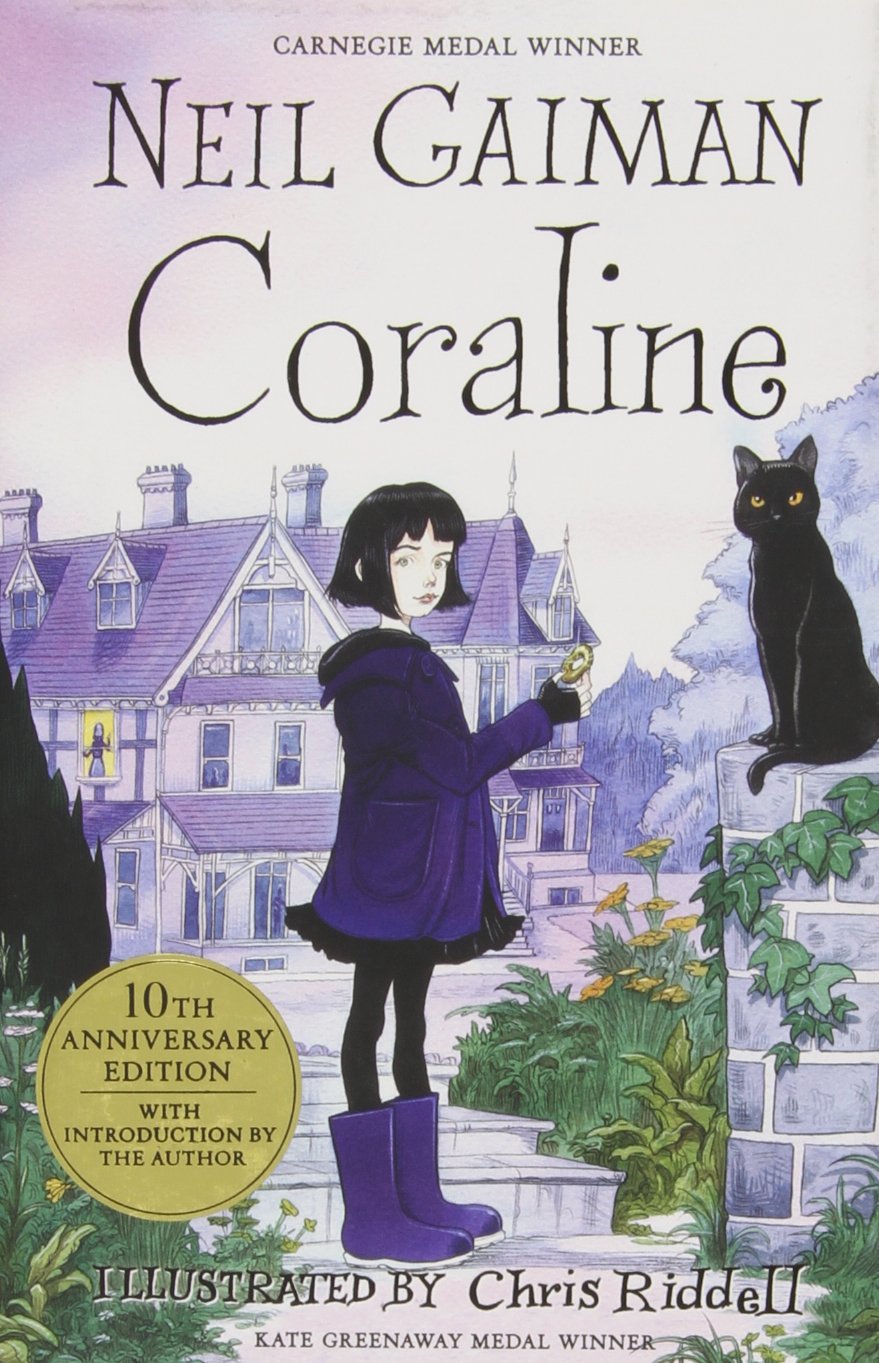
Review - Coraline


Coraline is one of those names I've heard for what feels like ages, but I never knew what the book was about.

I mean, literally no idea.

Ever since I read (and immensely enjoyed) Anansi Boys, I've been on a quest to get my hands on as many Neil Gaiman books as possible. It was about time, too!

Perhaps the best way to describe Coraline is creepy. I wouldn't go so far as to classify it as horror, more like a creepy fantasy. The heroine, Coraline, moves into a new house and she's immensely bored. Her parents don't have much time for her, so she spends the last days of summer vacation investigating the home and getting to know her neighbors--and they're a colorful lot.

But when Coraline discovers a small door into a walled-off apartment in the house, the story takes a dark turn. She crawls through the passageway and discovers another home almost like hers. I say almost, because this home is inhabited by the other mother--a charming woman identical to her mother with the exception of her long-fingered hands and her unsettling eyes. They are two big black buttons.

At first, the other mother (as well as the button-eyed other father) seem perfect. They're cheery and thoughtful and pamper Coraline with all the love and attention she feels she's been missing from her real parents. However, the story takes a sharp turn into creepiness when the other mother tells Coraline that she only has to do one little thing to be happy forever...

"It won't hurt."
When Coraline's real parents go missing, she's forced to confront her fears and embark on a quest to save them before the other mother takes control over her.

I really liked the concept and the creepiness behind the story, especially the part about the button eyes. The overall moral was also a nice, homely one. However, the action felt rushed, like the author wasn't giving us enough time for the plot points to set in. Maybe it's because it's a children's book and sometimes less is more, but I was yearning for just a little bit more.

Even so, being a kid's book, I think it's actually quite scary as is. Maybe a little too scary for some!


After reading the book, I decided to watch the film and was pleasantly surprised by the adaptation. The film incorporates several changes to the plot, the main one being the introduction of a new character, the little boy Wybie.

The reasoning behind including a new character in the film adaptation is so that Coraline doesn't spend the majority of the movie talking to herself. You see, there are many scenes in the book where she is alone with only her thoughts as company (there are also many scenes where she speaks with the cat, who is another important character). Internal dialogue works well on the written page, but on the big screen it could become an issue. An unobtrusive friendly character such as Wybie did the trick, in my opinion--and the appearance of the other Wybie is one of the strongest points for me in the film.

Another great novelty in the film is that we learn a tad more backstory about the other mother. Her motives and techniques are clearer from the beginning of the film. I found the book somewhat lacking on this point.

The ending to the movie was a bit of a letdown, though. To me it felt like it had fallen prey to Hollywoodish clichés and there was really no need to change the witty heroic and original ending which appears in the book. I was highly satisfied with the original ending, as it reminded me of old fairy tales where slyness and trickery save the hero. The film adaptation, on the other hand, ends with a gaudy KA-BOOM along with a dose of deus ex machina.

Overall, I give Coraline three and a half Pirates.


Tuesday, March 22, 2016

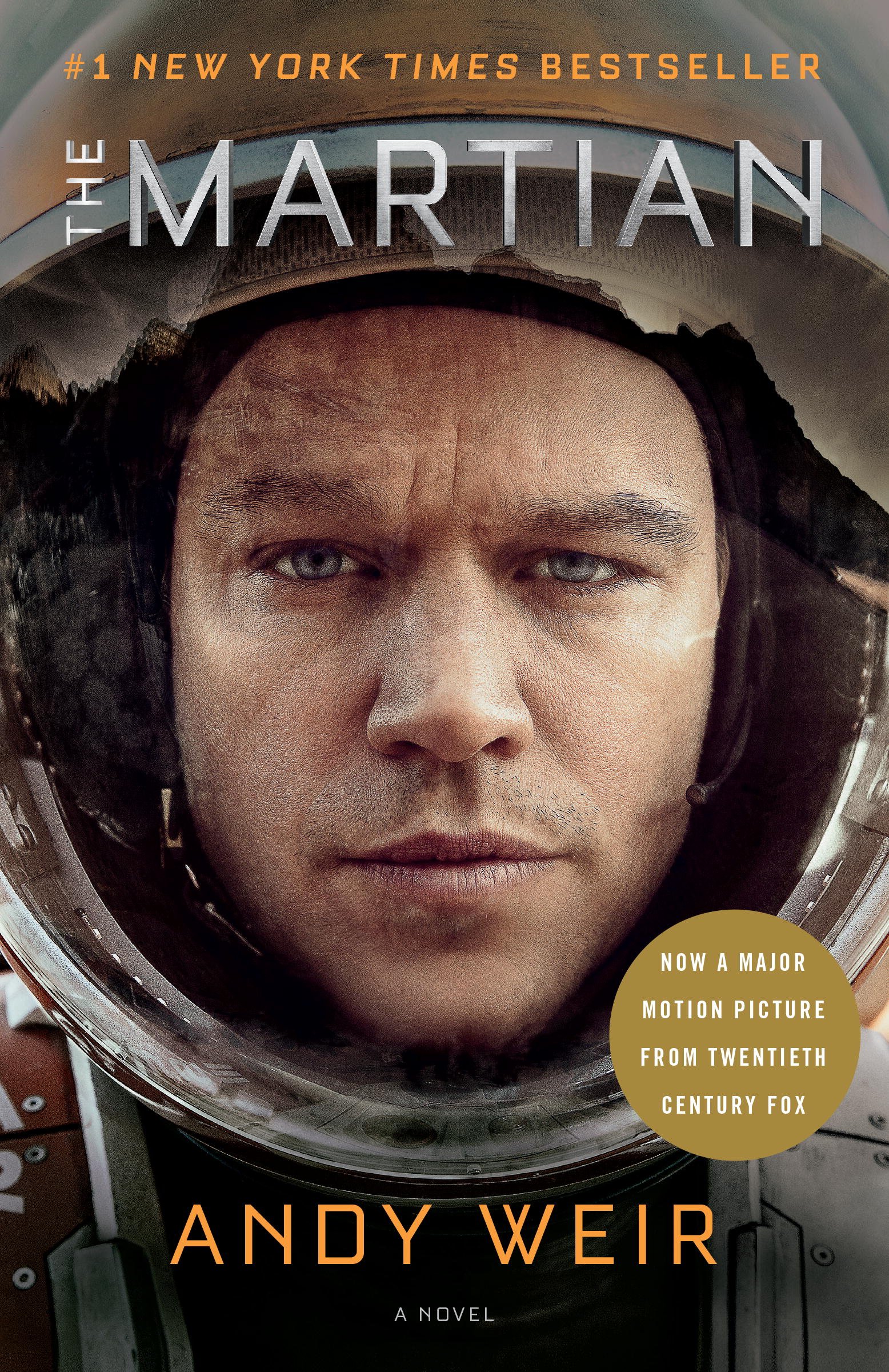
Review - The Martian

This is one of the few times I watched a movie and then read the book. (It's usually the other way around, or I skip the movie version altogether.) I'm sooo happy to say I was pleasantly surprised.

The Martian by Andy Weir kept me entertained throughout, and I kept searching for spare moments to read a bit more. Wanting to return to a book is a great sign. More so in my case because I had already seen the movie and, well, the ending is predictable. There are several events and even lines of Watney's log entries which were mimicked exactly in the film. There are differences, of course, and that's where in my opinion the novel has the upper hand.

Watney is more prevalent in the novel, since most of the chapters are him writing in the system's log, explaining how his day went. Scenes with NASA are his crew mates are short and to the point.

This is excellent if you, like me, feel sympathy for Watney. I mean, sure, he's stranded on Mars, who wouldn't feel sympathy for him, right? Well, Watney can be annoying and immature at times. Other readers on Goodreads have criticized him for his corny jokes and his overall flowery positive attitude. I actually enjoyed his corniness and thought it made him cute.

As for the positive attitude, the way I read the novel, I got the feeling that he wasn't allowing himself to feel despair. He was purposefully shutting off that part of his psyche. There are several moments all the way up to the end where he talks about the possibility of death and he always has a back-up suicide plan in case things go wrong, so I didn't get the impression he was oblivious--just forcing himself to keep a positive mind. That's admirable, in my opinion.

Even though I already knew the details of the ending, there were some scenes that literally gave me goosebumps; scenes involving the solitude of Mars and the possibilities of failure. Those were carried out well, in my opinion.

Nevertheless, not everything was perfect. There were a few things that got on my nerves. The endless mathematical calculations were all right at first, but nearing the end of the novel I just skipped over them. I don't have a mathematical mind, so just skipping all the calculations to reach the outcome was good enough for me. This wasn't really a big problem. It granted the story scientific credibility, even though there were moments when the action was heavily bogged down. I would have preferred more action than calculations, really.

Another problem I had, and this one is more important, is that all the characters in the novel came off as corny and somewhat immature. Their one-liners and little joke wars reminded me of things high schoolers would say--not NASA scientists. I don't think there was a single character who wasn't affected by this novel's overall corniness. This took away some of their credibility and made everyone have the same personality. Watney is a bit more fleshed out, since we see him a lot more, but he's still very similar to everyone else.

Speaking of Watney, we don't know any of his backstory. Nothing. We also don't really get to experience Mars (the sights, etc.). In all the logs we read, he only mentions in passing that he has parents in Chicago. It would have been nice to know a bit more about him than his present predicament. It also would have been nice to visualize the planet more.

Complaints aside, I still enjoyed The Martian immensely and I'm glad I both saw the film and read the novel.

I give The Martian four out of five Pirates!


Tuesday, March 15, 2016

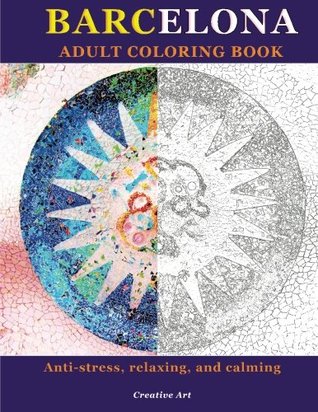
Review - Barcelona Adult Coloring Book

Barcelona Adult Coloring Book by Alexandru Ciobanu is a wonderful idea--just fabulous! Imagine coloring in all the Catalan works of art! Those mosaics! Those buildings!

If you know a little bit about me, you probably already know I live in the Barcelona area. I love this city, its history, its architecture, its daily bustle...

M'encanta Barcelona!

I received a free PDF copy of this book from the author through a Librarything giveaway, all in exchange for an honest review. Here goes the honest review.

When I saw the listing for this book on Librarything, I practically tripped over my own fingers in my haste to click to enter the giveaway. As I live near Barcelona and am a huge fan of the city, I couldn't wait to get my hands on a coloring book dedicated to my beloved Ciutat Comtal.

Unfortunately, I wasn't so happy when I looked inside. The photographs are excellent. The color and angle of each photo is exquisite. The so-called drawings, however, leave much to be desired. I refer to the drawings as "so-called" because, while the book's Amazon description uses this term, in reality the images given to us to color are no more than the result of filtering the photographs.

The filter used resembles the pencil sketch filter you can find on Photoshop. Here's a quick tutorial by Lesa Snider on Macworld on how to transform any photograph into a pencil sketch. As you can see, the process isn't too difficult once you have an idea of how Photoshop works. (I personally used to mess around with the program's filters for hours and hours.)

I don't see any problem with using a filter to modify the original photographs and turn them into something someone can color in. However, while looking through the coloring book, I felt it had been put together with haste. In general, the filtered images contain residual dots and lines that should have been cleaned up to make coloring them easier. Take this image of the antenna at the Parc Olímpic, for example:

Part of the original photograph.
Part of the image to color in. The sky around the antenna
hasn't been cleaned up, so we can see remains of the thin clouds
and airplane trails, which give the image an unfinished feel.

This happens throughout the book. Other photographs contain segments which are slightly overexposed, or too dark. The filtered image can't capture the lines if the original is too light or too shadowed, so we have sections where we encounter white spaces. For example, look at the filtered image of the mosaic on the book's cover:

The section on the left is lost
through the filtering process.

Overall, I'm sad. I so wanted to love this book. The idea is wonderful. The original photographs are excellent. The drawings are disappointing. In my case, instead of relaxing, I found them a bit frustrating and I realized my heart rate was going up while attempting to color them because I couldn't ignore the fact that they all looked dirty. There are a couple close-up images of mosaics which are just beautiful, and these work very well to color in.

Gorgeous!
Even so, just compare Barcelona Adult Coloring Book to Fantastic Cities: A Coloring Book of Amazing Places Real and Imagined by Steve McDonald, and you'll see a huge leap in quality.

In conclusion, with a little more touching up, Barcelona Adult Coloring Book could be a great pastime. Unfortunately, the way it's available right now, I can't give it any more than two and a half Pirates.


Tuesday, March 1, 2016

Review - Anansi Boys

If you've read my previous post, you'll know the very first book I finished in 2016 left a sour knot in my gut. Fortunately, I was reading another book at the same time, Anansi Boys by Neil Gaiman, and the adventures within its pages managed to wash away some of the frustration caused by The Boy in the Striped Pajamas.

Anansi Boys is immensely engaging from page one, I deeply enjoyed this story and its characters, from the old trickster Anansi to the victim-turned-hero Fat Charlie and even his suave and egotistical brother Spider. It's full of magic, of gods, and of adventure.

Readers can quickly sympathize with Fat Charlie's plight. He's the mild-mannered son of Anansi, the Spider god. Raised in Florida, Fat Charlie (who isn't really fat, but his father made up that nickname and it stuck) escapes to London the moment he has a chance. But when he receives news of his father's death, he must return to Florida and confront his past.

Fat Charlie's past involves a brother, one he didn't even know he had. When Spider, the long-lost sibling, shows up at Fat Charlie's home, things begin to get out of hand. Spider takes over everything in Fat Charlie's life; he causes complications at his workplace, makes himself his own magical bedroom (hot-tub included) in Charlie's closet, and even shows interest in Charlie's fiancée, Rosie.

Spider screws everything up for poor Fat Charlie, but I still adored him! In my opinion, this is the best aspect of Anansi Boys: no matter how much the brothers try to provoke each other's demise (and believe me, they do!), I still fell fully invested in each one.

As the story progresses, more and more elements of African folklore creep into Fat Charlie's surroundings. He decides he has to get rid of Spider once and for all before his life is officially ruined. I don't want to give anything else away, so you'll just have to read and see where the brothers' antics take you!

The only downside is that the resolution felt rushed and devoid of the magic I'd grown so accustomed to throughout the story. Nevertheless, Anansi Boys is a fun addition to my library, and one I'll surely read again.

Anansi Boys gets four out of five Pirates!


Tuesday, February 23, 2016

Review - The Boy in the Striped Pajamas

Well, my 2015 Reading Resolution was a huge bust. I managed to read all 18 Fullmetal Alchemist books, but not many others from my list... *Sigh.*

The year 2016 started off on the right foot. All the wedding preparations are behind me, so that takes a lot of pressure off my back!

Okay, I just said this year started off well, but the truth is the very first book I read in 2016 made me furious. And not because of the harrowing subject matter itself (the Holocaust), but because of how the author disrespected this subject and...well... any reader's intelligence.

The first book I read in 2016 was The Boy in the Striped Pajamas by John Boyne.

**This review contains SPOILERS.**

I've had this book on my "to-read" list for a long time, so when I recently saw it in the bookstore I thought "what the heck." After reading it, I can't fathom how so many people call it a masterpiece.

For starters, the children in the book read more as around six and eight years old instead of the supposed nine and twelve. Bruno, the German main character, is so naive that one cannot help but wonder if he suffers from some sort of mental retardation. I'm not saying this out of malice; I truly wondered if the author meant to portray him as a child with mental difficulties. I suppose the author wanted to show innocence and lack of malice, but it quickly became irritating and patronizing to children. Children aged nine are simply not as oblivious to the world around them as Bruno, and the way the author depicts children makes me think he doesn't have a very high opinion of them in general.

Moreover, with Bruno being the child of a German commandant in charge of Auschwitz, he should know basic concepts such as "Jew" or "Heil Hitler." Instead, he seems oblivious to absolutely everything. I would expect a German child--son of a commandant no less!--to receive a strict fascist education from the get-go. Perhaps already be a part of the Hitler Youth Groups. Instead, all this is overlooked and Bruno doesn't even know the meaning of "Heil" or who "this Hitler man" is.

Another downside in the book was the multiple play on words which only work in English, even though the characters are supposed to be speaking German. Bruno's use of "Out With" instead of Auschwitz gets old very fast, as well as the use of "Fury" for Führer. These mistakes just don't work because these words are completely different in German so the play on words only makes sense for English speakers. Even so, they're hammered in throughout the book and Bruno even has whole conversations about how he mistakes words--conversations about mistakes that are actually impossible for him to make!

Finally, the last straw for me was when Bruno mistakes the prisoners of Auschwitz for holiday-goers. I couldn't believe what I was reading. I kid you not: Bruno believes the people inside the metal fences aren't doing anything because they're "on holiday." The author, in my opinion, has gone too far. No child aged nine is so self-centered, blind and unobservant. Any child living in those extreme surroundings would be awake enough to know something isn't right. Sadly, this isn't the case for our dear Bruno.

The final pages of the book have been described as a "whirlwind." I feel (just a bit) like a horrible person for saying this, but the moment Bruno decided to cross the fence into the concentration camp, I was looking forward to his death. Even that fell flat. None of the characters were engaging and the piece ended up centered around an annoying boy living his oblivious privileged life until the final paragraphs, where we began to see some of the horrors the prisoners endured. But even then, everything was from Bruno's blundering point of view, and that felt immensely disrespectful to the true victims of the story.

In conclusion, The Boy in the Striped Pajamas felt like a mockery. The arguments "it's from a kid's point of view" and "it's meant to be a fable" are irrelevant to me. I found it offensive and distasteful on so many levels, starting with the way it misrepresents children to the way it skims over the victims of the concentration camp--don't forget that the second main character is a child living inside the concentration camp (a small child who, by the way, would have most probably been sent to the gas chamber during his first month there).

If you're interested in Holocaust stories, do yourself a favor. Skip The Boy in the Striped Pajamas and head straight for a true story, a Pulitzer winner, a masterpiece: Maus by Art Spiegelman.


The Boy in the Striped Pajamas frustrated and outraged me so much that I'm going to give it zero Pirates, which is really a shame because just look at that cute widdle face!


Thursday, February 18, 2016

On Being a Swiss Chard and Rambling About It

As a lifelong writing aficionada, I often wondered how writers do it. How do they give life to characters who are so different from them? Or are there writers who live vicariously through their characters' feats, even if the character is a downright scoundrel?

Take, for example, the character William Hamleigh from The Pillars of the Earth. This is a disgusting, loathful man, the epitome of villainous creatures (who several times in the novel walks the fine line of becoming a caricature). He rapes, he maims, he kills, and he enjoys it all tremendously. But does this show us who the author is?

There's an expression in Catalan which I particularly like: ets una bleda. Literally, it means "you're a Swiss chard." Figuratively, it means that you need to grow a backbone.

Well, when it comes to animal suffering I'm 100% bleda--spineless. I've cried rivers over all sorts of animals and had several nightmares where I wake up in a sweat and trembling like an absolute bleda. The first nightmare I remember having in my entire life involved my kitten getting flushed down the toilet. Another time, more recently, I was a factory worker in charge of snapping geese necks. Yet another time, I was a journalist following the story of a homeless man who would chase stray kittens, impale them, and eat them.

Awful, graphic stuff. So when I came across a dying kitten in the street, of course I scooped him up and rushed him to the vet. Of course I took him home and together with my husband Salva brought him back to life. Of course I cried for sleepless nights (the kitten had an awful habit of scratching his eyes at night and making them bleed--good thing we have a 24-hour veterinary hospital on our same street). And of course I acted like such a bleda that I even hurt my back (lumbago out of stress) and had to miss work.

All better now!
My feelings towards animal suffering are strong, but is that also true for my characters?

While Eneld Cross, biorobotics engineer, is quick to recite the Animal Protection Act, lovable sidekick Seth has a disturbing hobby of scooping out rat brains and inserting them into robot carcasses. Tristan Cross really couldn't care less about animal rights because he's got too many problems on his mind already, and the demonologist Robert Westbrook has performed acts of cruelty both on animals as well as humans--and demons.

Does this make me love them any less? Nope!

Let's return to Ken Follet's The Pillars of the Earth. There is a notorious scene in which the most villainous of villains revels in torturing a cat, I believe to death. My memory is fuzzy because once I saw where the action was heading I skipped the scene altogether. The graphic nature of the chapter was enough to make me want to stop reading the novel. Are Hamleigh's actions a reflection of Follet's beliefs or values or desires, or whatever you want to call it?

And what about the master of killing sprees? If you've ever read any of his work, you won't be surprised to know George R.R. Martin adores cats. Too bad most of his characters are mere humans! Even though his books are written in blood and several main animals and humans die, no cat comes to any harm. Arya chases cats for agility practice, but the kitties only receive a kiss on the nose once she catches them.

Sometimes I wonder if my characters' actions are, in some way, a reflection of myself.  If you've ever read any of my work, you'll know my protagonists are far from perfect. Tristan is foul-mouthed and has blood on his hands. Eneld, the "good brother" is a womanizer and starts off the series with a drug abuse problem. And these are the heroes--the ones we sympathize with! Antagonistic characters such as Robert have planned and done much worse (just have a look at The Soul Distillery).

To be honest, I haven't done any of the things my characters have (no murders, demonic worshipping or drug abuse over here, Your Honor!), but it's so darn fun to write about them!

So, maybe because I'm a Swiss chard in real life, my characters do the things they do.

What about you? Do your characters reflect parts of your personality? Do your characters show personality traits you find annoying, disrespectful, loathsome?

Sunday, March 15, 2015

2015 RR - The Vision by Dean Koontz

I'm no Dean Koontz fan, but I somehow ended up with four or five of his novels in my home library. The third book I tackled for my 2015 Reading Resolution is The Vision. For the life of me, I couldn't find an online image of the edition I have (a 1987 reprint), so I took a picture myself.

What can I say about this book? Hmmm... Uh... It reads quickly? I actually abandoned it several years ago due to the painful dialogues, and only read it now to complete my resolution. Needless to say, I didn't enjoy it.

Plot

Mary, best-selling author who lives with her new husband Max in Bel Air, is a clairvoyant who visualizes murders before (and sometimes while) they occur. She helps police intercept the killers before they can continue their rampage. However, one day Mary's visions change: she can feel the pain of the victims and she fears for her life. It seems the murderer knows she's observing him, and is after her.

Pros

A quick, effortless read.

Cons

There are so, so many things I didn't enjoy about this book. For the sake of brevity, I'll give you a list of my top peeves.

1) The story itself it crammed with clichés up until the final showdown with the villain, who (of course) takes the time to give a fully detailed recount of all his antics and motives before swooping in for the final kill.

2) The characters feel like paper cutouts and constantly share "as you know, Bob" conversations. It's ridiculous to read page after page of characters explaining things to each other--things they both already know! There has to be a more elegant way to transmit back story. I'd prefer a simple narrative paragraph every now and then instead of having the characters talk to each other like they're all going through acute bouts of amnesia.

3) The writing style itself is sometimes irritating. In this novel, Koontz seems to have developed some sort of allergy to conjunctions. What happened to the humble "and"? Gone. Here are some examples:

     - He sat up, switched on the lamp, looked around the room.
     - He let go of her wrist, pushed his hair back from his forehead.
     - At last the intense, dark-skinned young man stood up, helped the blonde to her feet.

I wouldn't mind if these parallel structures appeared every now and then, but here we're talking about page after page.

4) Another problem I have is the amount of scene breaks. The novel feels like it was written for a TV drama. We get two paragraphs, scene break, two more paragraphs with the same character five minutes later, scene break. Is it really necessary to cut scenes every time a minute goes by? Where's the flow? Just have a look at page 189 of my edition:

  7:00 P.M.
     Mary squeezed Max's hand and waited tersely. Any minute the walkie-talkie would crackle with a report from one of the deputies. [One more longish sentence.]
  7:03.
     Mary repeatedly glanced at her watch in the back glow of the police cruiser's headlights. She shifted restlessly from one foot to the other.
  7:04.
     For the first time in more than an hour, Chief Patmore looked at her, met her eyes. He wasn't happy.
  7:06.
     She was beginning to feel that she had been outmanoeuvred, outwitted. [Two more sentences.]
  7:09.
     She was numb with fear. "Something's wrong," she said.
     "What is it?" Max asked.
     [Scene continues for a very brief conversation and then we cut again to 7:30.]

In this case, the cuts are meant to increase tension, but come on. I just--I just can't. No. Really. I can't.

5) The author attempts to slip the reader a big fat red herring, but in my opinion fails miserably. So much attention is drawn to a single character in an attempt to make the reader think he's the culprit, that it quickly becomes uncomfortable and embarrassing.

The Vision is one of Koontz's earlier works--but not his first. Have another look at that cover. Yeah, it boasts he's the author of Strangers and Darkness Comes. Inside the book, we have a list with a total of seven Koontz titles. So, The Vision might be an early Koontz novel, but with seven others under his belt, I would hardly call it the work of an amateur.


*Sigh*

I'm not a big fan of giving bad reviews, but I can't lie, either. At least it's a quick, mindless read.


Bonus rant round!

Take a load of this conversation from page 20:

     "What a mayor you are," [Harry Oberlander] said with heavy sarcasm. "Hiring a witch to do police work."
     Henderson responded like a weary giant spotting yet one more tiny challenger with delusions of grandeur. "She's not a witch."
     "Don't you know there's no such thing as a witch?"
   
What did I just read? Oberlander accuses Henderson of hiring a witch. Henderson responds that she isn't a witch. Oberlander reminds Henderson that witches don't exist. Then why does he even accuse Henderson of hiring a witch in the first place?


Final round: The Longest Sentence in the History of Sentences

I'm not saying this sentence is bad. It does its task perfectly and really sets the scene. Do you want to read it? Do you? It contains spoilers, so only proceed if you dare.

Pages 244-245:

     Even before he completed the thought, the knife ripped into him, rammed out of darkness and into him, felt like the blade of a shovel, enormous, devastating, so devastating that he dropped the gun, feeling pain like nothing he'd ever known, and he realised that the killer had pitched the flashlight aside as a diversion, hadn't really been hit at all, and the knife was withdrawn from him, and then shoved hard into him again, deep into his stomach, and he thought of Mary and his love for Mary and about how he was letting her down, and he grappled with the killer's head in the dark, got handfuls of short hair, but the bandage came off his finger and the cut was wrenched open again and he felt that pain separate from all the others and he cursed the sharp edge on the car's jack, and the flashlight his the floor ten feet away, spun around, cast lunatic shadows, and the knife ripped loose from him again, and he reached for the hand that held it, but he missed, and the blade got him a third time, explosive pain, and he staggered back, the man all over him, the blade plunging again, high this time, into his chest, and he realised that the only way he could hope to survive now was to play dead, so he fell, fell hard, and the man stumbled over him, and he heard the man's rapid breathing, and he lay very still, and the man went for the flashlight and came back and looked down at him, stood over him, kicked him in the ribs, and he wanted to cry out but didn't, didn't move and didn't breathe, even though he was screaming inside for breath, so the man turned away and went towards the arch, and then there were footsteps on the tower stairs, and, hearing them, he felt like such a useless ass, outsmarted, and he knew he wasn't going to be able to recover his gun and climb those stairs and rescue Mary because stuff like that was for the movies, pain was pulverizing him, he was leaking all over the floor, dripping like a squeezed fruit, but he told himself he had to try to help her and that he wasn't going to die, wasn't going to die, wasn't going to die, even though that was exactly what he seemed to be doing.

And that's it for The Vision! I haven't had much time to post on the blog recently, but I have had time to read. I just finished the fourth book in my 2015 Reading Resolution list: The Princess Bride. Well...I finished the main story but still had to read the epilogue of sorts, and then my cat puked on the book so now I'm not sure if I actually got the nerve to finish those last pages...

Thursday, January 29, 2015

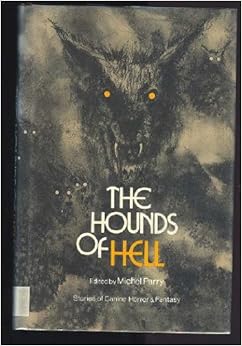
2015 RR - The Hounds of Hell

Oh, happy day! Today I finished the second book from my 2015 Reading Resolution list!

The Hounds of Hell: Stories of Canine Horror and Fantasy, edited by Michel Parry, receives a solid four-star review from me.

Let's begin with the basics. The short stories in this collection all revolve around canines, be they good, evil, spectral, or even real pets. The book I own is the hardcover 1974 edition (I have a soft spot for older books versus newer editions). Most of the stories therein range from the early to mid twentieth century--probably my favorite decades for fantasy and horror.

Some of the stories are entertaining, some pull you right in...and others fall flatter than a pancake. Did I say pancake? No. Something even flatter. A crepe. Stick with me and you'll see.

Let's have a quick roll call, shall we? I'll include the story's title, author, and first sentence, along with my personal verdict.

The Hound, by H.P. Lovecraft
In my tortured ears there sounds unceasingly a nightmare whirring and flapping, and a faint, distant baying as if of some gigantic hound.

KVerdict: Not bad, although Lovecraft 's flowery style does get to me sometimes (I know, the time period...). I have several of his books, but sadly am not a great fan of his work. This story isn't an exception. It's just all right.

Staley Fleming's Hallucination, by Ambrose Bierce
Of two men who were talking one was a physician.

KVerdict: The first of many stories in this collection to have someone stalked by a phantom dog and ultimately get their throat ripped out. *Yawn.*

The Dog, by Ivan Turgenev
"But if you once admit the existence of the supernatural, and that it can enter into the ordinary affairs of everyday life, allow me to ask what scope is left for the exercise of reason?"

JVerdict: An excellent story with a rather slow opening. The Dog has the honor of being the only story to make a chill run through me. Once again, the character is stalked by a dog during the night. This dog, however, is warning him of what's to come...

The Hound of Death, by Agatha Christie
It was from William P. Ryan, American newspaper correspondent, that I first head of the affair.

KVerdict: A nun dreams of things which she believes never existed, but seem more real to her than life. Could she be remembering backwards?--Seeing what's to come? The symbolism, the premonitions, the signs... There is a distinct cult feel around this story, which nonetheless lacks something, as if it weren't completely fleshed out.

Dead Dog, by Manly Wade Wellman
They brought the rebel chief Kaflatala out of the jungle to Father Laboissier's mud-brick house, brought him in a tepoia because he still limped from a Portuguese bullet in his thigh.

JVerdict: Although Dead Dog repeats the premise of a person being stalked at night by a vengeful hound, the African setting, so different from the other stories in the collection, made for an interesting read.

The Dutch Officer's Story, by Catherine Crowe
"Well, I think nothing can be so cowardly as to be afraid to own the truth," said the pretty Madame de B., an Englishwoman, who had married a Dutch officer of distinction.

KVerdict: A ghostly hound wakes up sentries who are asleep on their watch, so of course someone higher up decides to see what happens if he shoots the creature. I don't understand why so many of the characters in these stories feel the need to shoot at dogs.

Vendetta, by Guy de Maupassant
Palo Saverini's widow dwelt alone with her son in a small, mean house on the ramparts of Bonifacio.

KVerdict: This is one of the few stories where the dog is a regular, living breathing pet--trained to kill.

Dog or Demon? by Theo Gift
"The following pages came into my hands shortly after the writer's death."

JJVerdict: Excellent storytelling by Victorian novelist Dora Havers (under a male pen name, of course). Probably what I loved most about this story is the fact that, even though it takes place in 1878 Ireland, the topic of eviction (with all its paperwork and personal drama) is so similar to what could happen nowadays--if you don't include the curses and the phantom killer dog (again).

Louis, by Saki
"It would be jolly to spend Easter in Vienna this year," said Strudwarden, "and look up some of my old friends there."

JVerdict: At first I was a bit disgusted. Murder your wife's beloved pet just to be able to go on vacation? However, once the murder plan is carried out and the truth is discovered, the story deserves a chuckle.

The Howling Tower, by Fritz Leiber
The sound was not loud, yet it seemed to fill the whole vast, darkening plain, and the palely luminous, hollow sky: a wailing and howling, so faint and monotonous that it might have been inaudible save for the pulsing rise and fall; an ancient, ominous sound that was somehow in harmony with the wild, sparsely vegetated landscape and the barbaric garb of the three men who sheltered in a little dip in the ground, lying close to a dying fire.

JJVerdict: The protagonists of this story, Grey Mouser and Fafhrd, are the protagonists of a series of short stories. The Howling Tower starts off a bit slow, and the point of view is so distant it's at times difficult to grasp, but once the action begins it's a tale full of imagination that I won't mind reading again.

The White Dog, by Feodor Sologub
Everything grew irksome for Alexandra Ivanova in the workshop of this out-of-way town--the pattens, the clatter of machines, the complaints of the managers; it was the shop in which she had served as an apprentice and now for several years as seamstress.

LVerdict: This is probably the flattest story in the entire collection. The beginning is all right and promises something like revenge or at least a good fight between Alexandra and a Tanechka, the youngest seamstress. What follows, however, is just awful. I'll just explain it, so if you don't want any spoilers please stop reading here. After being called a dog by Tanechka, Alexandra goes into a rage and returns home, where she ponders her existence and the round, full moon. There is ambiguity about whether or not she is a shape shifter. Driven by a force stronger than her will, Alexandra tears off her clothes and runs outside, where she lies on the ground and howls at the moon. Two neighbors see what they believe is a massive white dog, so logically (¿?) they run out and shoot it...

"The discharge of a rifle sounded in the night air. The dog gave a groan, jumped on its hind legs, became a naked woman who, her body covered with blood, started to run, all the while groaning, weeping and raising cries of distress. The black-bearded one and the curly-headed one threw themselves in the grass and began to moan in wild terror." THE END

Seriously? Put some Nutella on that crepe and serve it to me hot.

The Hound, by William Faulkner
To Cotton the shot was the loudest thing he had ever heard in his life.

KVerdict: I could have enjoyed this American South story more if the writing weren't so disjointed. There are several passages--especially descriptions of places and series of actions--where it seems the author just skipped over entire sentences. I don't know if this style is intentional to fit the protagonist, but it made for a confusing read.

The Emissary, by Ray Bradbury
Martin knew it was autumn again, for Dog ran into the house bringing wind and frost and a smell of apples turned to cider under trees.

JJVerdict: An excellent story told in an excellent voice--probably, my favorite from the collection, in fact. Little boy Martin is perpetually sick and bed-ridden, but his faithful Dog tells him everything of the outside world through the smells and brambles (and other stuff...) he brings back in his fur. The ending had a very strong Pet Sematary feel to it, which was juuuuust fine.

The Hound of Pedro, by Robert Bloch
They said he was a wizard, that he could never die.

JVerdict: Another excellent story revolving around wizardry and black magic, this time in 1717 Mexico. The depictions of violence and cruelty are exceptionally vivid in this one, so it's not for the faint of heart.

The Whining, by Ramsey Campbell
When Bentinck first saw the dog he thought it was a patch of mud.

LLVerdict: Horrible! Awful! I never want to read this again! When I began reading this collection, I had some reservations as I was worried that some of the stories might depict cruelty to a "real" (not phantom, not satanic) dog. This story fed my fears. And of course, the protagonist loses his marbles in the last line or two. How convenient. Nope.

The Death Hound, by Dion Fortune
"Well?" said my patient when I had finished stethoscoping him, "have I got to go softly all the days of my life?"

JJVerdict: Once again, an excellent story told by an excellent storyteller, Violet Wirth, "the most influential female occultist since Madame Blavatsky." The Death Hound features occult detective Doctor Taverner, who uses his wit and a dose of white magic to thwart an attempt at mental assassination. How come I never heard about this author or this character before? *Runs off to find more Taverner stories!*


And that concludes my analysis of The Hounds of Hell. Overall, it was an enjoyable read, though the topic of killer dogs did become a bit repetitive (I can't blame anyone--it's a collection of stories about killer dogs!). The best result of reading this collection is that now I know more authors and more characters I can look up. Doctor Taverner, here I come!

Would you like to read The Hounds of Hell?

What book should I strike off my list next? I was thinking about reading The Vision by Dean Koontz, merely because it's completely different to what I just read. However... I remember the first pages being so sappy... I guess I'll have to soldier on through it, right?
Related Posts Plugin for WordPress, Blogger...