Showing posts with label Etymology. Show all posts

Monday, May 23, 2016

Semantic Change - Broadening - Part 2

Words constantly change meaning. It's something inevitable that happens due to usage. This process is called semantic change or shift in meaning. I posted a general explanation about this previously, and now I'm going to focus on one of the ways a word can change its meaning: broadening.

Broadening is basically a process in which a word used to refer to something specific goes on to refer to something more general. Its meaning broadens, widens, becomes more general.

In my previous post on semantic broadening, I used several brand names as examples. Names such as Kleenex or Velcro are commonly used nowadays not to refer to the specific brand, but to refer to the general object. Other words such as "escalator" or "aspirin", previously brand names, lost their trademarked status and became part of the public domain. This is yet another example of semantic broadening, and in the case of brands, "genericide."

Here are some other examples of broadening:

Guy
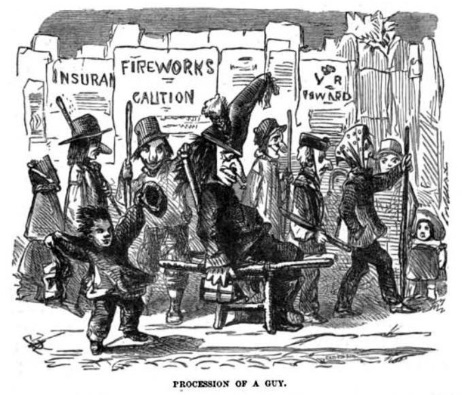
Procession of a guy.
This word nowadays refers to any male person. It originates from Guido (Guy) Fawkes, the most famous of a group of conspirators who attempted to blow up the English Houses of Parliament on November 5, 1605. This was known as the Gunpowder Plot. You might recall a little rhyme from the movie V for Vendetta mentioning this.

After Fawkes's trial and execution, Londoners began celebrating the thwarted plot each November 5 with bonfires, fireworks, and the burning of an effigy, which was called a guy (but usually represented the Pope).

During the 19th century, the word "guy" was used to refer to any oddly dressed person. In America, the word lost its pejorative connotation and came to mean any man, and that's the use we give the word today.


Ezio Auditore is the most
charismatic assassin ever!
Assassin

The origin of this word is as twisted as you would expect! It seems that in the eleventh and twelfth centuries there was a secretive murder cult which received the name "hashishin" meaning "hashish eaters."

This cult targeted prominent figures and also took money from contract killings. Even though their main goal was to coerce or murder, the group wasn't as bloodthirsty as you'd think. They were highly intelligent and trained killers, known for only inflicting harm on their target. They specifically took care not to harm bystanders or any innocent people who might be nearby.

Because of their assaults were focused on prominent figures, the words "assassin" and "assassinate" nowadays refer to killings of a major public figure. If an ordinary everyday person is killed, that is murder, not assassination.


Dog

The Old English word "docga" (or "dogga") is still a linguistic mystery. At the time, the word "docga" was used to refer to a specific breed of canine, but once it entered the language it gained popularity to the point that it forced out the Old English "hund" (which gave us today's "hound") and went on to mean any sort of dog disregarding its breed.

Thing

Is there a more general word than "thing"? Well, in Old English (it was "þing") the word referred to a council, meeting, assembly or discussion. It's incredible how generalized this word has become and how forgotten its origins are!

Shit

Oops! Sorry for cursing! No, not really. I honestly don't have any taboos when it comes to language because the word itself isn't inherently right or wrong; its the connotations we humans give it. So, let's talk about shit.

Originally, the word referred to fecal matter, and it still does today. However, its sense has been broadened. Have you ever heard phrases such as:

"I've had enough of her shit."
"I have so much shit to to today."

I'm sure most of you must have. In the first example, the word "shit" might refer to "problems" or "issues" or "drama" or "complaints." It's very general! In the second example, "shit" is also immensely general, meaning "things."

What's happening to the word "shit"? It's undergoing a process of generalization or broadening, but it's also on the verge of losing any meaning! When a word becomes so, so general, it risks losing its full meaning and becoming nothing more than a function word (used to express grammatical or structural relationships in a sentence) or an affix (a word element: prefix, suffix...). This process is called bleaching.


Resources

http://etmlbristol.wikia.com/wiki/Semantic_widening

http://grammar.about.com/od/ab/g/broadenterm.htm

http://www.todayifoundout.com/index.php/2012/12/where-did-the-word-assassin-come-from/

http://www.etymonline.com/index.php?term=thing&allowed_in_frame=0

http://www.etymonline.com/index.php?term=dog&allowed_in_frame=0

http://grammar.about.com/od/ab/g/broadenterm.htm

http://www.krepublishers.com/02-Journals/IJES/IJES-07-0-000-14-Web/IJES-07-3-000-14-ABST-PDF/IJES-7-3-711-14-338-Kaburise-O/IJES-7-3-711-14-338-Kaburise-O-Tx[32].pdf

Monday, May 16, 2016

Semantic Change - Broadening Part 1 - Brand Names

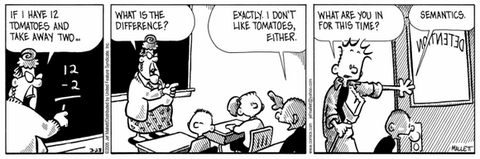
Semantics! Yay!

Oh, come on! It isn't that bad... Here's a comic strip to get you in the mood.


Semantic change (also called shift in meaning) is a process in which a word changes its meaning over time. It actually happens a lot more than you'd expect! There are many words which we happily toss around in our everyday conversations which started out with a completely different meaning. Let's have a look at a few words that underwent a form of semantic change called broadening.

Also called widening or generalization, the process of broadening a word's semantics means that it takes on a more general sense.

Perhaps the most obvious use of broadening is related to brand names. Over the years, we've grown accustomed to using a specific brand name to refer to a general idea or item. Can you find all the brand names here?

When Julie finished her shift at the mall, she had a massive headache and really needed an aspirin. As she got on the escalator, she remembered she had some in her backpack. She checked all the pockets--even the ones shut with Velcro--but the only things she could find were some Kleenex, ChapStick and Band-Aids.

Easy, right? The brand names are capitalized: Velcro (registered name for "hook-and-loop fastener"), Kleenex (registered name for "facial tissue" or "handkerchief"), Band-Aid (registered name for "adhesive bandage") and ChapStick (registered name for "lip balm." Note the capitalized "s" in the middle).

That looks weird, doesn't it? Especially "ChapStick"! I'm so accustomed to using it as a generic name that seeing it capitalized is a bit unnerving. But have a glimpse at the official website and, yup, it's a registered trademark.


However, there are two more trademarked names in that segment: aspirin and escalator. But why aren't they capitalized?

Well, it turns out that these words lost their trademark status.

Let's begin with the easy one:

The word "escalator" was trademarked by Otis Elevator Co. in 1900, but in the 1950 case Haughton Elevator Co. v. Seeberger, the company lost its trademark rights because the court declared it had allowed the word to become generic, meaning nothing more than "a moving staircase." Thus, the company lost its trademark and "escalator" officially became part of the public domain.

The word "aspirin" was trademarked by the well-known German pharmaceutical Bayer in the year 1899. However, at the end of World War One, many of the company's assets and trademarks were confiscated and other companies jumped at the opportunity to use the highly acclaimed name. Bayer, however, still holds trademark in over eighty countries, including Germany, Canada and Mexico.

By the way, did you know that Bayer had also trademarked "heroin"? The name of the drug is actually diacetylmorphine. However, Bayer created its brand name Heroin from the Greek word "hero" in order to associate "heroic" traits to the medicine. As you might have guessed, the company also eventually lost trademark rights over this word.

These last two examples (three if we count "heroin") of semantic broadening are also clear examples of a phenomenon called brand genericide--when a brand name becomes a common name. Otis Elevator Co. failed to properly protect its trademark over the word "escalator", and Bayer pretty much had its trademark stripped from "aspirin" after WWI.

Other companies are currently at risk of losing their trademark this way, for example "Google" with regards to the common phrase "let's google this", meaning "let's look this up on the internet."

Brand name broadening has happened many times, and probably will continue to happen throughout the decades. It's a form of dying of success: the trademarked name becomes part of your day-to-day until you disassociate it from its source (the company) and use the name solely to refer to the item. Once we've reached this point of semantic broadening or generalization, court claims can be put forward to declare the word public domain--and other companies can jump at the opportunity to use a well-known word.

So, it turns out semantic change isn't something that only affects us nerds! The evolution of language has deep and long-lasting effects on society, and phenomena such as shifts in meaning have, as we've just seen, even been dealt with in court cases.

In my next post I'll give you some examples of broadening which affected regular words we use every day.


Resources

http://etmlbristol.wikia.com/wiki/Semantic_widening

http://inventors.about.com/library/inventors/blaspirin.htm

http://www.bayer.com/en/history.aspx

http://ndrichardson.com/blog/2012/09/11/brand-genericide-when-brand-names-become-commonplace/

http://www.bbc.com/news/business-27026704

http://www.businessinsider.com/yes-bayer-promoted-heroin-for-children-here-are-the-ads-that-prove-it-2011-11?op=1

Tuesday, April 26, 2016

Hey, Nimrod! - Etymology and Shifts in Meaning

"Hey, nimrod! How's it going?"

That wasn't very nice, was it? Chances are that if you greet someone like that you might just get a punch in the face, or at least a sour look. However, "nimrod" wasn't always an insult--it is actually a biblical name.


According to the Bible, Nimrod was the great-grandson of Noah, and the first person to play a large active role after the great flood. He was an expert hunter and the ruler of Shinar. Shinar is a biblical geographical region in Mesopotamia which has been historically linked to Babylonia. In fact, "The Land of Nimrod" is used in the Book of Micah (Micah 5:6) as a synonym for Mesopotamia or Assyria.

Although the Bible doesn't clearly state this, it is common belief in both Hebrew and Christian traditions that Nimrod was the leader who oversaw construction of the Tower of Babel. This connection was made mainly because the location of the tower fell in the heart of his kingdom.

With all this information, I can assume that Nimrod was considered an important and powerful man in biblical history. He was a mighty warrior and skilled hunter, the ruler of Shinar... 
So how did his name come to mean "idiot" or "inept"? You won't believe the answer...


In a Looney Tunes cartoon featuring Bugs’s fumbling nemesis Elmer Fudd as a hunter on the rabbit’s trail, the carrot-chomping coney sardonically refers to Fudd as a nimrod — insulting him by derisively comparing him to a biblical personage renowned for his hunting skills. Apparently, later generations of Looney Tunes fans who hadn’t kept up with their Scripture picked up on Bugs’s attitude without understanding the ironic allusion, and the word acquired a new meaning, while its original sense faded into the background.[1]


So, it seems we can thank Looney Tunes for this (unintentional) shift in meaning. Basically, Bugs Bunny's use of sarcasm equates to him saying something like: "Nice going, Einstein!"--where "Einstein" is used as a sarcastic form of "genius." As the name Nimrod was not well-known among its viewers, the meaning shifted over time.


However, just how true is this allegation? There are those who believe Bugs Bunny wasn't being sarcastic when he called Elmer Fudd "Nimrod." There are those who believe Bugs was using "Nimrod" directly as a synonym for "idiot," much in the same way Americans use "Benedict Arnold" for "traitor."

The reasoning is simple: let's suppose it was Nimrod who oversaw construction of the Tower of Babel. Some interpretations see Nimrod as an arrogant tyrant who ordered the massive tower to reach the heavens and make a name for the people. Some describe him as a rebel who defied God by constructing the gargantuan monument. The endeavor didn't end well...

Up until that point, the bible claims all humans spoke the same language, but God decided to put an end to the Tower of Babel absurdity by causing people to speak different languages and scattering them over the globe. This event is known as the "confusion of tongues."

So who was responsible for all this confusion and scattering? Nimrod, the ruler, of course. He dared defy God, and he was an idiot for doing so. Thus, some believe the Looney Tunes script purposefully used the name Nimrod as an insult--no sarcasm needed.

Which is the true explanation for this shift in meaning? We may never know...


Extra:

By the way, I would also like to point out that other interpretations of the Bible see the Tower of Babel as a cradle of civilization, and the "confusion of tongues" not as a punishment, but as a way of explaining cultural differences around the world. This interpretation immediately reminds me of Rudyard Kipling's Just So Stories, where the author gives interesting explanations of how some things came to be (how the elephant got its trunk, how the camel got its hump, etc.).


Resources

[1] Daily Writing Tips - Accidental Shifts in Meaning

http://christianity.about.com/od/biblestorysummaries/p/towerofbabel.htm

http://biblehub.com/topical/n/nimrod.htm

Monday, April 11, 2016

Why Women Are Hysterical - Etymology

"You're just being hysterical."

We've all heard it. Common in everyday English, "hysteria" refers to uncontrolled levels of emotion. It can have positive connotations, as when we refer to something being very funny (hysterical), but it can also have negative connotations, mainly towards women.

Even though now it feels insulting to be referred to as "hysterical," the term originally derives from medicine and was once used as a formal diagnosis.

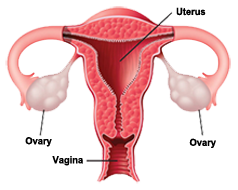
"Hysterical" (and all its variations) has its origins in Ancient Greek. The Greek word hystera means "womb" or "uterus." In Classic Greece, it was believed that a "wandering womb" or displaced uterus caused emotional problems in women: hysteria.

Ancient Egyptian documents such as the Kahun Papyrus, dating from 1900 BC, already mention psychological disorders derived from movements of the uterus. The very father of medicine Hippocrates was the first to coin "hysteria." For centuries (well into the Renaissance), "hysteria" was applied as a medical term to refer to practically any disorder in women. Even though medicine was theoretically based on empirical knowledge and observation, social roles and stigmas were crucial in shaping the diagnosis of women's diseases.

In the time of Hippocrates, women virtually had no rights and went from being controlled by their fathers to being controlled by their husbands. In the very cradle of democracy, women couldn't vote or even attend assemblies. Natural aspects of women's biology such as menstruation and hormonal changes were ignored or completely misunderstood. Famous philosophers such as Aristotle claimed women were unfit for education or politics because of their "bad biology."

So, due to all these social factors--and contradicting the inherent empirical nature of medicine--practically any ailment that befell a woman was considered hysteria--a result of a wandering womb. The term "wandering womb" is literal. The Greeks literally believed the uterus could move around inside a woman's body. For example, if the uterus wandered to the lungs, it could cause death through "hysterical suffocation."

Treatment for the wandering womb could be tortuous. Some physicians applied honey or other sweet-smelling substances to the vulva in an attempt to lure the uterus back to its original place. Others made the women chew strong or disgusting substances, from cloves of garlic to excrements in an attempt to frighten the uterus away from the upper torso. In some cases, physicians performed a hysterectomy, a total removal of the uterus. Other times, the "disorder" was attributed to a dry or bored uterus, and the woman was given a prescription of marriage, sex, and childbearing to keep it occupied.

In more recent years, the term "hysteria" has been dropped from the medical field in favor of other, more concrete terms. Medicine has become more specific and (finally!) more empirical regarding women's diseases. Even so, gender, sexism and society still play a very important role in understanding women. Just think about all the jokes you've heard about PMS.

In 1931, the gynecologist Robert Frank coined the term "premenstrual tension" and in 1953 the physician Katharina Dalton expanded on his theory and coined "premenstrual syndrome," colloquially known as "PMS." In medicine, this term refers to the physical and mental changes a woman might undergo before menstruating. In everyday life, however, PMS has been used many times to have a laugh. From sitcoms to web comics, the natural biology of women's bodies is still treated as a beast, as something grazing the mystical and unknown.

And it's not just the nature of the beast, but also the treatment. I'm sure we've all heard some sort of "She's bitchy because she hasn't been laid" comment sometime in our life. Although it's a joke, all jokes hide some underlying truth or belief, and it seems sex is still the prescription for a troublesome womb. It makes me wonder just how far we've come in these four thousand years.


Resources

http://academic.mu.edu/meissnerd/hysteria.html

http://chsi.harvard.edu/bok/02.html

http://thechirurgeonsapprentice.com/2012/08/07/o-wandering-womb-where-art-thou/

http://www.ncbi.nlm.nih.gov/pmc/articles/PMC3480686/

http://www.maximhy.com/blog/2014/12/04/where-does-the-term-pms-come-from/

Thursday, March 31, 2016

Metaphors in Medicine - Glands

Check out my first post on metaphors in medical terminology here.

In this post, I'm going to focus on glands. A gland is an organ which secretes substances. We have several glands in our bodies, and these can be divided into two big groups depending on where they release their products:

- Endocrine glands - These secrete substances into the bloodstream, for example the pituitary gland secretes hormones.

- Exocrine glands - These secrete substances into ducts which ultimately lead to the outside of the body, for example sweat, tears, milk... Gastric glands (lining the inner walls of the stomach) are also considered exocrine glands, since they release gastric juices into a duct (the stomach) and not the bloodstream.

Just look at all those little glands!
The word gland itself has a metaphorical origin. According to Etymonline, the English form gland comes from the French glande (Old French glandre). This word, in turn, comes from the Latin glandula, which is a diminutive of glans. The word glandula was used to refer to the tonsils ("gland of the throat"), but the word was later extended to all glands in the body.

The Latin word glans, from which the term originates, means "acorn, nut, acorn-shaped ball." This online Latin dictionary also mentions "bullet thrown from a sling."

The word glans is still used in English today, and it refers to the rounded tip of the penis or the clitoris. I'm not going to add any pictures, but I'm sure you can see the similarity with an acorn! Actually, current-day Spanish (glande) and Catalan (gland), which originate from the same Latin term, have the exact same same anatomical sense. What's more, in Catalan, the word gla (coming straight from Latin) means acorn. In Spanish, an acorn is a bellota. The term probably comes from Arabic, which might have taken the word from the Greek "balanos."

But I'm getting off track.

Let's have a look at a couple glands. I was going to include the thyroid gland here, but its story is so complicated that it deserves its own post, which I'll get to soon.


Pineal Gland

This tiny gland nestled deep in the brain has been historically linked to spirituality. It's been called the third eye and the eye of Horus, and philosophers such as Descartes have claimed it is the "seat of the soul."

For a long time, not much was known about the actual physiology of the gland. Nowadays, we know it is in charge of releasing the hormone melatonin, which helps you maintain your circadian rhythm; your sleep-wake periods. The special thing about melatonin and the pineal gland is that production of the hormone and release into the bloodstream both depend on light. Secretion is very low during the day and higher once the sun sets.

As of today, researchers still don't know if the gland is responsible for other bodily functions.

The name in English comes from the French pinéal, which means "like a pine cone." The French form comes from the Latin pinea ("pine cone"), which derives from pinus ("pine tree").

Pine cones--presumably representing the third eye and the seat of the soul--are present in
many cultures worldwide. Have a look at this website for some neat information.

Ovary

The ovaries are in charge of releasing an ovum every month, as well as releasing several female hormones such as estrogen. The word "ovary" comes from the Modern Latin ovarium. This term descends from Medieval Latin ovaria, meaning "the ovary of a bird." The root word is the Latin ovum, simply meaning "egg." The Spanish and Catalan terms for ovary also originated from Latin, and are ovario and ovari, respectively.

The word "oval" shares the same origin as "ovary." They both descend from the Latin word meaning "egg."

In Classical Latin, the word ovarius meant "egg-keeper."

In modern-day English, we still rely on the Latin term to refer to the eggs which the ovaries release: one egg is an ovum. The plural is ova. In Spanish, the eggs are called óvulos, whereas in Catalan they are òvuls (these are the plural forms with the -s).


Resources

Monday, March 28, 2016

Metaphors in Medicine - Anatomic Metaphors

Metaphors are a way of understanding life. Humans have used metaphors practically since the dawn of time to make sense of the world around them. It's easier to understand something new and unknown if you can find a point of similarity between it and something you are already familiar with.

The body seen as a house.
Sometimes we tend to think that metaphors are strictly artistic forms of expression. The truth couldn't be any further. Metaphors have a strong presence in science and technology. For example, we constantly (and unconsciously) hear and use metaphors when talking about computers (my computer has a virus).

We can find metaphors in medicine when we refer to anatomy (see the examples below), and also physiology (white blood cells combating against germs). Much of the medical terminology we use nowadays originates from Latin or Greek. Many of these terms started off as metaphors, but their metaphorical meaning has been forgotten over time.

Here are just some examples of anatomic metaphors to start off this series.


Muscle

The term "muscle" reached English through Middle French. It comes from the Latin word "musculus," which is a diminutive form of "mus." The word "mus" means mouse. So, the word muscle originates from "little mouse." Ancient anatomists found that certain muscles (especially the biceps) looked like little mice.

Watch out, Tom! That mouse
has some muscle!
The ancient Greeks also made the same analogy between mouse and muscle, and they used the word "mys." This word is still present in medicine as the prefix "myo-," used to refer to muscles (for example, the heart: myocardium).

The shellfish "mussel" comes from exactly the same Latin origin, the "little mouse." For many years, English didn't have any distinction in spelling between "muscle" and "mussel."


Uvula

Do you know that little dangly thing at the back of your throat? That's the uvula, and its function is to close off your nasal cavity when you swallow so that food doesn't go up into your nose. Its name comes from the Latin word uvola, meaning "small bunch of grapes."  The Latin word uva (meaning "grape") is still used in Spanish to refer to this fruit. In Spanish, the uvula is "úvula," and it also commonly called "campanilla," which means "little bell." This is yet another metaphoric term for an anatomical element.

Vitreous
The eye is full of metaphors!

Literally, "vitreous" means "glassy" or "glasslike." The word comes from the Latin "vitreus" ("glassy"), which stems from "vitrum" ("glass"). The "vitreous humor" refers to the transparent gel inside the eye.

The term "in vitro" also comes from the Latin "vitrus," meaning that fertilization takes place "in glass" instead of in the body.

Iris

The word "iris" hasn't changed from its original Latin form. It was used to refer to the iris plant, the iris of the eye, and also rainbows. In Greek, it had the same form, "iris," and also the same functions. The Greek goddess Iris was the messenger of the gods, and was the personification of a rainbow. The region of the eye was called "iris" because it gave the color of the eye. In Spanish, a rainbow is called "arco iris" ("iris arch").

Lenticular

This word originates from the Latin "lens," which means "lentil." In English we also use "lens" in several contexts: a camera lens, the crystalline lens of the eye (anatomy). "Lenticular clouds" are clouds which resemble lentils.


These are just a few examples of metaphors which have become an integral part of our anatomy. Stay tuned for more!
Related Posts Plugin for WordPress, Blogger...