Showing posts with label Metaphors in Medicine. Show all posts

Monday, June 20, 2016

Metaphors in Medicine - The Body As A House + Some Sci Fi

Over the course of history, people have used metaphors to explain the new and unknown. Metaphors offer us a point of anchoring when approaching complex or novel issues. By relating something new to something we already know, it becomes easier for us to understand it and make it our own.

The human body has been subject to hundreds of metaphors. In a previous post, I commented on a few anatomic metaphors. In this post, I want to be more general and speak of the human body as a whole. Across history, the body itself and all its systems have been likened to a house, a machine, and, more recently, a plant.

First of all, let's take a look at the human body as a house. Here is possibly one of the earliest, or at least most well-known, representations of this metaphor:


The Polish-Jewish physician Tobias Cohn published a series of eight books called the Ma'aseh Toviyyah (Work of Tobias). Each encyclopedic volume focused on a field of knowledge (Volume One: Theology, Volume Two: Astronomy, Volume Three: Medicine...). In the third volume, Tobias Cohn illustrated the human body side-by-side with a house in order to liken both structures.

The Bible makes several references to the body as the home of the person's essence, the physical place where the soul resides. The body may be mortal, but the soul most certainly is not! Thus, the soul merely occupies a home during its stay on Earth.

To nobody's surprise, works of science fiction have dealt with the subject of body and home. Have you ever heard of superior beings leaving behind their physical bodies and living only through the psyche? This transformation occurs to our hero Dave at the end of his adventure in 2001: A Space Odyssey. While his fate might not be so clear in that novel, subsequent novels leave no place for doubt: Dave, with the help of the superior race, has left behind his mortal body--his home or shell--and become a superior being himself, unrestricted by space and time. This concept is nicely addressed in the book How to Live Forever: Science Fiction and Philosophy by Stephen RL Clark.

While the entire body might be considered a house, what is it a house to? Apart from the "soul," there are many representations of the brain as the center of one's essence. Science fiction, again, has dealt with this and I'm sure most of us are familiar with the brain in a jar scene.

Red Dwarf: Poor Lester has a nasty shock when
he sees his possible future self in a jar.
Essentially, the idea is that if we can transfer the brain from one body to another, moving from one house to another might save us from certain death if the rest of the body fails (the house falls apart).

But what about taking it one step further? The brain is also prone to decay, and it is also part of the physical home of the intangible soul, so what if we leave behind absolutely everything? What if we could upload our memories and our emotions--essentially ourselves--into a digital format and exist in a form of digital immortality?

In an attempt to cheat death, science fiction has postulated that humans can use artificial limbs until the mortal body is completely eradicated. The next step from there would be to discard the artificial bodies and thus the soul, or the psyche or whatever you would like to call it, is free from its home.


Further Reading

http://motherboard.vice.com/read/leaving-the-body-behind-a-history
http://www.middletownbiblechurch.org/whatisap/wiap03.pdf
https://neuwritesd.org/2013/10/29/the-science-non-fiction-of-a-bodiless-brain/
http://arstechnica.com/the-multiverse/2015/03/its-a-sci-fi-trope-but-are-beings-of-pure-energy-really-possible/

Friday, April 29, 2016

Metaphors in Medicine - Fertilization - A Personified Battle

Over the years, I've heard bumbling parents utter the phrase "Daddy planted a seed in Mommy" in films, television series, and who knows where else. It's become a cliché.

Last year, a friend of mine was expecting. She wanted a girl and the father wanted a boy. One evening, we were out on the street and several of the father's friends came up to us and started talking about the future baby. The conversation was full of macho phrases like "Prove you're a man and make a boy." Even though the guys were essentially joking around, the expressions still struck me.

My friend had a baby girl, by the way.

I am a strong believer that all jokes hold some truth, a glimpse into the psyche of the joke-teller. Even though these friends were joking around about making a baby boy, their words revealed an underlying belief that the man is in charge of selecting the baby's sex. And the baby's sex depends on or is a reflection of his manhood.

Of course, there is some scientific data to back this idea up. A woman has XX chromosomes whereas a man has XY chromosomes. Thus, all women's eggs will have an X chromosome whereas men's spermatozoa will have either an X or a Y. Up to here, that's all science.

However, what about the lexis surrounding reproduction? Dozens and dozens of articles I've skimmed through repeat the same tropes: The woman is a vessel. The woman's egg is a passive player, waiting for the sperm to reach it. The man is the active player. His spermatozoa swims and races to reach the egg.

It's been commonly taught to us that the first sperm cell to reach the egg is the winner. It decides if the baby will be a boy or a girl. It gets to fertilize the egg.

However, have you ever seen a video of fertilization? That ovum is surrounded by sperm cells!


So, is it really a matter of being the first one to win the race? Or perhaps fertilization is based on complimentary chemical reactions? The answer is chemistry, of course!

Have a look at this website from the Advanced Fertility Center of Chicago for a step-by-step explanation of the fertilization process.

So, it seems fertilization is infested with metaphors (plant a seed, the woman is a vessel) and something else: personification. Personification is a technique in which you grant human qualities to non-humans. These can be animals (the cat smiled with satisfaction) or objects (the dark towers sneered down at me).

If you have a look above, you'll see several instances of personification marked in italics. As with metaphors, personifying things helps bring them closer to us: it makes them more relatable. Nevertheless, some articles go a bit overboard. Just take a gander at the website What to Expect and their explanation of the fertilization process. For example (bold added):

But only one of those sperm will be crowned the victor in the frenzied fight to the fertilization finish, and it's a battle that's fraught with dangers lurking at every twist and turn of your reproductive tract (no one said it's easy being a sperm).

This website not only illustrates personification of the sperm, but it also incorporates another well-used technique in medicine: battle language. I will make a future post centered on battle language, but let me quickly mention that it is persistent in medical speech: you fight a disease, the virus attacks, you win or lose the battle with cancer...

Fertility is no less. The website What to Expect delights in giving us the following battle metaphors: fortify the troops, call in the transport unit, gather steam, check the coordinates, battle to the finish, mission accomplished.

It seems battle expressions and personification serve to make the text more pleasant to follow, less "sciency", and perhaps bring it closer to the reader and make it thus more relatable. What do you think?

Thursday, March 31, 2016

Metaphors in Medicine - Glands

Check out my first post on metaphors in medical terminology here.

In this post, I'm going to focus on glands. A gland is an organ which secretes substances. We have several glands in our bodies, and these can be divided into two big groups depending on where they release their products:

- Endocrine glands - These secrete substances into the bloodstream, for example the pituitary gland secretes hormones.

- Exocrine glands - These secrete substances into ducts which ultimately lead to the outside of the body, for example sweat, tears, milk... Gastric glands (lining the inner walls of the stomach) are also considered exocrine glands, since they release gastric juices into a duct (the stomach) and not the bloodstream.

Just look at all those little glands!
The word gland itself has a metaphorical origin. According to Etymonline, the English form gland comes from the French glande (Old French glandre). This word, in turn, comes from the Latin glandula, which is a diminutive of glans. The word glandula was used to refer to the tonsils ("gland of the throat"), but the word was later extended to all glands in the body.

The Latin word glans, from which the term originates, means "acorn, nut, acorn-shaped ball." This online Latin dictionary also mentions "bullet thrown from a sling."

The word glans is still used in English today, and it refers to the rounded tip of the penis or the clitoris. I'm not going to add any pictures, but I'm sure you can see the similarity with an acorn! Actually, current-day Spanish (glande) and Catalan (gland), which originate from the same Latin term, have the exact same same anatomical sense. What's more, in Catalan, the word gla (coming straight from Latin) means acorn. In Spanish, an acorn is a bellota. The term probably comes from Arabic, which might have taken the word from the Greek "balanos."

But I'm getting off track.

Let's have a look at a couple glands. I was going to include the thyroid gland here, but its story is so complicated that it deserves its own post, which I'll get to soon.


Pineal Gland

This tiny gland nestled deep in the brain has been historically linked to spirituality. It's been called the third eye and the eye of Horus, and philosophers such as Descartes have claimed it is the "seat of the soul."

For a long time, not much was known about the actual physiology of the gland. Nowadays, we know it is in charge of releasing the hormone melatonin, which helps you maintain your circadian rhythm; your sleep-wake periods. The special thing about melatonin and the pineal gland is that production of the hormone and release into the bloodstream both depend on light. Secretion is very low during the day and higher once the sun sets.

As of today, researchers still don't know if the gland is responsible for other bodily functions.

The name in English comes from the French pinéal, which means "like a pine cone." The French form comes from the Latin pinea ("pine cone"), which derives from pinus ("pine tree").

Pine cones--presumably representing the third eye and the seat of the soul--are present in
many cultures worldwide. Have a look at this website for some neat information.

Ovary

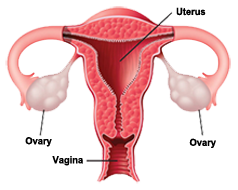
The ovaries are in charge of releasing an ovum every month, as well as releasing several female hormones such as estrogen. The word "ovary" comes from the Modern Latin ovarium. This term descends from Medieval Latin ovaria, meaning "the ovary of a bird." The root word is the Latin ovum, simply meaning "egg." The Spanish and Catalan terms for ovary also originated from Latin, and are ovario and ovari, respectively.

The word "oval" shares the same origin as "ovary." They both descend from the Latin word meaning "egg."

In Classical Latin, the word ovarius meant "egg-keeper."

In modern-day English, we still rely on the Latin term to refer to the eggs which the ovaries release: one egg is an ovum. The plural is ova. In Spanish, the eggs are called óvulos, whereas in Catalan they are òvuls (these are the plural forms with the -s).


Resources

Monday, March 28, 2016

Metaphors in Medicine - Anatomic Metaphors

Metaphors are a way of understanding life. Humans have used metaphors practically since the dawn of time to make sense of the world around them. It's easier to understand something new and unknown if you can find a point of similarity between it and something you are already familiar with.

The body seen as a house.
Sometimes we tend to think that metaphors are strictly artistic forms of expression. The truth couldn't be any further. Metaphors have a strong presence in science and technology. For example, we constantly (and unconsciously) hear and use metaphors when talking about computers (my computer has a virus).

We can find metaphors in medicine when we refer to anatomy (see the examples below), and also physiology (white blood cells combating against germs). Much of the medical terminology we use nowadays originates from Latin or Greek. Many of these terms started off as metaphors, but their metaphorical meaning has been forgotten over time.

Here are just some examples of anatomic metaphors to start off this series.


Muscle

The term "muscle" reached English through Middle French. It comes from the Latin word "musculus," which is a diminutive form of "mus." The word "mus" means mouse. So, the word muscle originates from "little mouse." Ancient anatomists found that certain muscles (especially the biceps) looked like little mice.

Watch out, Tom! That mouse
has some muscle!
The ancient Greeks also made the same analogy between mouse and muscle, and they used the word "mys." This word is still present in medicine as the prefix "myo-," used to refer to muscles (for example, the heart: myocardium).

The shellfish "mussel" comes from exactly the same Latin origin, the "little mouse." For many years, English didn't have any distinction in spelling between "muscle" and "mussel."


Uvula

Do you know that little dangly thing at the back of your throat? That's the uvula, and its function is to close off your nasal cavity when you swallow so that food doesn't go up into your nose. Its name comes from the Latin word uvola, meaning "small bunch of grapes."  The Latin word uva (meaning "grape") is still used in Spanish to refer to this fruit. In Spanish, the uvula is "úvula," and it also commonly called "campanilla," which means "little bell." This is yet another metaphoric term for an anatomical element.

Vitreous
The eye is full of metaphors!

Literally, "vitreous" means "glassy" or "glasslike." The word comes from the Latin "vitreus" ("glassy"), which stems from "vitrum" ("glass"). The "vitreous humor" refers to the transparent gel inside the eye.

The term "in vitro" also comes from the Latin "vitrus," meaning that fertilization takes place "in glass" instead of in the body.

Iris

The word "iris" hasn't changed from its original Latin form. It was used to refer to the iris plant, the iris of the eye, and also rainbows. In Greek, it had the same form, "iris," and also the same functions. The Greek goddess Iris was the messenger of the gods, and was the personification of a rainbow. The region of the eye was called "iris" because it gave the color of the eye. In Spanish, a rainbow is called "arco iris" ("iris arch").

Lenticular

This word originates from the Latin "lens," which means "lentil." In English we also use "lens" in several contexts: a camera lens, the crystalline lens of the eye (anatomy). "Lenticular clouds" are clouds which resemble lentils.


These are just a few examples of metaphors which have become an integral part of our anatomy. Stay tuned for more!
Related Posts Plugin for WordPress, Blogger...