Showing posts with label Books for Writers. Show all posts

Monday, February 25, 2013

Books for Writers # 5: Starve Better, review by Steven Young

Today's post is a book recommendation for all us writers, by fellow CCer Steven Young. He grew up in a village you've never heard of, but currently calls South London home. A marine biologist of sorts, he works at sea out of exotic locations like Singapore, Antarctica and North Yorkshire. With a single fluke short story sale, he is not yet a writer (or that's what he'd want us to believe...), but day by day, he learns.

You can find Steven on Critique Circle, along with the rest of us. Take it away, Steven!

When I discovered Starve Better: Surviving the Endless Horror of the Writing Life by Nick Mamatas, my head was spinning. I’d devoured all the how-to books and blogs I could find. And suddenly- oh my!- there were all these rules I had to follow! “Never use adverbs,” I was confidently informed. “Said-bookisms are a bad idea,” another source snarled. “Your writing will be ruined by passive voice,” said yet another. I felt paralysed, as though my mind was being poisoned by advice-overload. When I saw the opening chapter, “All Advice is Terrible Advice, Plus Other Useful Advice,” I knew I’d found my antidote.

After listing a bunch of, often contradictory, rules (“don’t be a pretentious Little Miss Fancy Britches. Make your prose purple and poetic,”) the author proceeds to debunk the very notion; pointing out that there “are no rules. Only the results matter.” The Harry Potter books, for example, are infamously littered with adverbs, and at least a few people seem to like them.

Before going further into his critique of traditional writing wisdom, the author detours briefly to highlight one recurring focus of the book worth emphasising here. He is primarily a short fiction writer, and much of what is said stems from that. This section is interesting in itself, going into the reasons why someone would write short fiction; for all that it is so uncommercial. And the reasons why someone should not write short fiction made me reassess some of my own assumptions. Turns out, it is neither easier than writing a novel, nor good practice for doing so.

The author goes on to discuss various structural elements of storytelling. One chapter discusses the importance of choosing a focus for the story, for a writer to capitalise on their strengths and downplay their weaknesses. Not every author can be a master of the intricate plot. Not every writer can break the reader’s heart with their characters’ plight. Work out what you are good at. Do it.

Something currently close to my heart is that dread beast- The Hook (Quick! Read the first sentence of this post again. Did it draw you in? If you’ve gotten this far, hopefully so. But believe me, I fretted about it.) The author has issues with the phrase ‘start with a hook.’ He considers the hook the “motor of the story.” It can be many things, from an unexpected plot twist to the quality of the writing itself, and can be found at any point in the story. Too often, ‘start with a hook’ leads a writer to include whizz-bang excitement in the first paragraph, followed by pages of irrelevance. No. The important thing is to begin the story at the place when the story actually starts. The purpose of the beginning is to show the reader that the writer knows what they are doing.


Via analysis of the role of the sentence in writing (including several pages rhapsodising about two sentences from a story by Raymond Chandler) and advice on writing dialogue (listen) he gets to an interesting discussion about how to end stories. Specifically, he suggests writers avoid neat, everything-is-resolved endings, to “leave room for that post-reading daydream”.

The part of the book dealing with the writing process itself ends with perhaps the most important question. “Why Bother?” Why deal with rejection after rejection, instead of self-publishing immediately. Reputation, essentially. Whilst I’m not sure I agree with his claim that being “not terrible” is sufficient for publication (as I think back to my own rejections, I certainly don’t want to agree), I can’t help but see publication as a kind of ‘proving ground’ for new authors.

The second half of the book shifts emphasis towards the nitty-gritty of getting cash for words. The focus is very much on non-fiction. The chapter on publishing non-fiction includes some eye-openers. I had no idea how much better paid non-fiction can be compared to fiction! He takes the reader through the process of finding and soliciting markets, and highlights the differences from fiction- work your way up, not down, and don’t bother trying to find market listings and submission guidelines.

The author also mentions writing for non-publication. Remember, this is all about fast money, not getting a six-figure advance and the Pushcart Prize. As he describes gigs from writing business letters to church newsletters, he gives the impression of being bloodhound of writing, forever sniffing around for the next easy dollar.

Considerable space is devoted to content mills and his time ghost writing term papers for students. Content mills seem to be the sweatshops of the writing world, with writers churning out online fluff for a pittance. There are perhaps ethical concerns regarding the ghost writing but I’m reviewing the author’s book, not his moral code, so whatever your stance, he highlights yet another way of getting paid to write.

This book may not be for everyone. It looks at the world of professional writing with a cynical eye. It may poke holes in fondly held preconceptions about writing, but does so with a distinctive acerbic wit. Despite being the very definition of the “barely published neophyte writer” whom the author disparages, and despite all advice being terrible, here’s some advice. If you are open to a perspective that differs from the norm, if you want to know more about life in the writing trenches, if you want to be entertained, read this book.


Thank you for your review, Steven. It's been great having you here!

Sunday, February 10, 2013

Books for Writers #4 - Characters, Emotion and Viewpoint


(Sorry for the delay posting this, but I somehow managed to superglue the pages of the book together...)

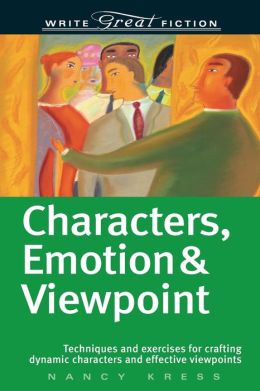
This week’s recommendation is Characters, Emotion and Viewpoint by Nancy Kress. It's part of the Write Great Fiction series, and a great read for anyone wishing to add more depth to their stories.

Characters, Emotion and Viewpoint is loaded with useful advice, information and exercises that you can apply from the very beginning--no matter the writing stage you're in.

Chapters one to seven focus on creating deep and believable characters, chapters eight to eleven discuss emotion, and chapters twelve to sixteen manage point of view. The transition from one topic to another is very well done and easy to follow, as each chapter builds on the previous ones.

Kress delves into so much detail—and offers so much advice—that it's difficult to choose just a couple points to comment on in this review. There's just so much going on in this book and it's all so great!

For example, in the chapters on how to create characters, the author defines each type of character, gives advice on making (good or bad) first impressions, tackling a character's social masks and true motivations, offering interesting backstory, giving your characters inner turmoil and conflicting desires… She even gives specific character portraits for genre fiction (characterization in romance, in westerns, in sci-fi...). 

A great chapter on characterization is Chapter 5: Showing change in your characters—If I knew then what I know now. Showing character change and development can be, as Kress says, overwhelming. Her main advice is to break down the task and write in scenes—and specify exactly what each scene "is supposed to accomplish". I have to admit I learned a lot from this section, and have been trying my best to apply it to my own work.

After the section on characterization, the author goes on to comment emotion. Kress offers us this great example:

All the following statements […] are made spontaneously by characters who have just learned that their dogs have been run over by a speeding truck:

- "Oh my God, no! No! Oh, not Cinnamon—no!"
- "Goddam $#%@*& driver! I'll kill him!"
- "Where is she? Can I see her? Who picked up the body?"
- "Did she suffer? Oh, please say death was instantaneous!"
- "I just let her out a minute… oh, God, I should have put her on the leash… oh, it's my fault… poor Cinnamon…"

- Silence.

All these examples are very short, yet they already show us character emotions—and character traits, thus reminding readers of everything we learned in previous chapters. See how it's all linked together?

Other techniques Kress comments on while discussing emotion are clichéd techniques, showing emotion through metaphor and sensory detail, special cases of emotion (loving, fighting and dying) and frustration. Yes, the author dedicates an entire chapter to introduce frustration as a valuable tool to nudge characters along and keep readers interested. Very interesting indeed!

As for point of view, Kress starts out by defining protagonist and point of view character, and then gives advice on how to choose the point of view character, as well as how many there should be (hint: as few as possible to still tell your story).

After giving a quick description of each type of point of view (first, third, and omniscient—as well as experimental and combinations of first and third), the author gives us in-depth information and guidance on the three main types of point of view. This is great help for anyone who struggles with defining clear points of view.

All in all, Characters, Emotion and Viewpoint is yet another great reference book for creative writers. If you’re having trouble showing emotion, if your characters act more like paper dolls than real people, or if you need some guidance on choosing the right point of view, this is a must-read! Along with The Emotion Thesaurus, it can give you all the tools you need to breathe life into your story.


Apart from the wealth of exercises at the end of each chapter, another added perk to this book is that each chapter contains special question boxes with writing-related topics, for example:


Question: Is a thesaurus useful in writing descriptions of people and places?
Answer: A thesaurus is either a great aid or a disastrous deceiver, depending on how you use it. [The author then goes on to give an explanation.]

I don’t know what I would have done without it! (And yes, I managed to salvage the pages I had glued together...)

Sunday, January 27, 2013

Books for Writers #3 - The Emotion Thesaurus

For the past couple of weeks, I've been recommending helpful books for writers. The first one was Self-Editing for Fiction Writers. The second one was Beginnings, Middles and Ends. This week, I'd like to talk about an excellent resource to help you add variety to your characters' emotions: The Emotion Thesaurus by Angela Ackerman and Becca Puglisi.

What word can I use to describe Ackerman and Puglisi other than AWESOME? These two ladies are in charge of The Bookshelf Muse, an award-winning blog by writers, for writers. If you haven't checked out their site yet, give it a click. I'll take a seat.


Ackerman and Puglisi certainly know what they're talking about--and they love to share, which is great for all of us! On The Bookshelf Muse, you'll find tons of helpful (and free!) information organized in sections:

- Character traits thesaurus
- Weather and earthly phenomena thesaurus
- Colors, textures and shapes thesaurus
- Setting thesaurus
- Symbolism thesaurus

and their current project: Physical attribute thesaurus.

Without a doubt, Ackerman and Puglisi are thesauri experts!

Oh, and did I mention all these thesauri are absolutely free?

There is an exception to all these freebies, though, and it's the book I'd like to recommend this week: The Emotion Thesaurus. On sale in digital and print format, it is yet another wonderful addition to every writer's library. But beware! This is not a how-to guide to writing and describing emotions, as some one- and two-star reviewers on Amazon believed, it is--as its title clearly announces--a thesaurus.

The Emotion Thesaurus offers information on 75 different emotions, arranged alphabetically, ranging from adoration to denial, embarrassment, guilt, relief, suspicion and worry. The authors dedicate two pages to each emotion, and offer the following information:

- Definition
- Physical signals - these are external signs perfect for when your point of view character is observing someone else experiencing this emotion.
- Internal sensations - perfect for describing the point of view character's emotion from the inside.
- Mental responses - again, perfect for the point of view character.
- Cues of acute or long-term [emotion]
- May escalate to [other emotions]
- Cues of suppressed [emotion]

Let's see this through an example. I'll open to any random page:

Envy

Definition: resentful awareness of an advantage enjoyed by another, paired with a longing to acquire that advantage.

Physical signals:
staring
glowering
the mouth turning down
flaring nostrils
muscles bunching
[...] [There are many, many more elements in this list.]

Internal sensations:
quick heartbeat
rising body temperature
dry throat
[...]

Mental responses:
a strong desire to touch, hold, and own
anger at the unfairness or injustice
[...]

Cues of acute or long-term envy:
feeling that life isn't worth living without the advantage
grabbing or stealing the coveted object
[...]

May escalate to:
determination (54), resentment (130) [...] [The numbers refer to the page where you can find the entry for the emotion.]

Cues of suppressed envy:
congratulating or offering praise
forcing a smile
[...]

This is just a sample of what you might find in any given entry. I purchased this book when I had already finished the second draft of my novel, and was struggling with edits. I had a whole lot of jaw clenching and teeth gritting going on! One critiquer on Critique Circle actually mentioned that I have some sort of fascination with human jaws... It was a little embarrassing, but funny.

So how did The Emotion Thesaurus help me? It gave me ideas to add more variety to my character's expressions. It helped me think outside the box I had built around myself, and offered me hundreds and hundreds of new possibilities. Now I have it by my side whenever I go through my work, and I check it constantly to see if I can use a different expression to show what my characters are feeling.

Apart from the thesaurus itself, which is already a great buy, The Emotion Thesaurus contains a short explanation at the beginning with information on the power of emotion, balancing it all out, telling instead of showing, using clichéd emotions, melodrama, etc. This is just another added bonus. You can get a taste of these opening explanations by clicking the look inside option on Amazon.

In conclusion, The Emotion Thesaurus is yet another great resource for writers! I'm glad to add it to my bookshelf.

Happy writing!

Sunday, January 20, 2013

Books for Writers #2 - Beginnings, Middles and Ends

Last week, I posted an article with several tips for beginning writers. I recommended observing how established writers crafted their prose, joining a critique group, and studying writing how-to books. In the post, which you can see here, I reviewed--and recommended--Self-Editing for Fiction Writers by Renni Browne and Dave King.


This week, my book recommendation is Beginnings, Middles and Ends by Nancy Kress. It is part of the series Elements of Fiction Writing.

As might be expected, the book is divided into three clear parts:

Part I: Beginnings
Part II: Middles
Part III: Endings (Note the title says "ends" but the book mentions "endings"--just a small detail I wanted to share.)

Each part is comprised of three chapters brimming with explanations, advice, examples and exercises. I must admit there is so much information in each chapter that it might seem overwhelming at first. For example, in Chapter 1, called The Very Beginning: Your Opening Scene, Kress highlights the importance of knowing your story's implicit promise to readers. She then goes on to describe characterization, conflict, specificity and credibility. Once she has described the elements of a successful beginning, she comments on how to put them all together to create an opening that works.

Because there is so much valuable information, Kress has added a summary and several exercises to the end of each chapter. The exercises are designed to make you reflect on various aspects of story building so, unlike last week's book, Beginning, Middles and Ends doesn't contain a suggested answer key.

I personally recommend reading each chapter through from start to finish, and then going back for a slower read with a highlighter and a pencil to jot down notes.

When describing techniques to build successful middles, Kress delves into how to develop the promise established in the beginning, choosing the direction of your story, planning the climax, tackling character development, and overcoming writer's block. All great information to get you through to the end!

As for endings, the author sums up their importance beautifully:

"At its beginning, a story makes the kind of implicit promise we've discussed throughout the book. In the middle, the development of both characters and conflict extends that promise by arranging forces in opposition to each other. We see, through skillfully chosen patterns of events, various problems and tensions come closer and closer to collision. Then comes the ending. It must use those same characters, conflicts, problems and tensions to show us the collision (the climax)."

From here on, Kress offers advice on how to deliver the story's promise, how to portray the climax and denouement, and how to reach the very end: the last paragraph, the last line. This is particularly great, since sometimes we need a helping hand up to the last period.

Apart from offering writing techniques, Beginnings, Middles and Ends is a great addition to any writer's collection because it also offers moral support. Yep. Kress is aware of the turmoil we authors constantly live in. She knows, ooohhh how she knows! She even includes sections in her book dedicated exclusively to getting writers out of a rut:

"Common reasons for getting stuck on either a short story or a novel are fear of failure, fear of success, literary fogginess, and wrong direction. In addition, novelists may get stuck if they become overwhelmed by the sheer magnitude of writing a novel: in the page count, the time investment, and the stamina required."

Kress then goes on to explain each of the reasons for getting stuck, and she mentions techniques to help get unstuck. In addition, she adds in a short section about techniques that won't get you unstuck.

To sum up Beginnings, Middles and Ends--and what a great addition it makes to every writer's bookshelf--, I would like to share a review written by A. Wolverton on Amazon.com:

"After reading 'Beginnings, Middles and Ends,' any beginning writer will have many of the tools needed to put together a good story or novel. Kress takes the reader through a step-by-step process that makes you think, 'It's so simple. Why didn't I think of that?' It's so simple because Kress has expertly targeted the areas that most writers have trouble with and has offered workable solutions. Her writing is very clear and readable. The examples and exercises alone are worth the price of the book. If you are interested in writing fiction and can only buy one book, this is the one."

Sunday, January 13, 2013

Books for Writers #1 - Self-Editing for Fiction Writers

Back when I was a reckless teen and computers trembled in my presence, I thought that my writing would get better just through practice. The word just is important here. I used to think that if I wrote a lot, about whatever I wanted, my writing would improve.

I was on the right track, I guess, but there were some major flaws in my logic.

While constant practice is an important factor, it's not the only thing you should rely on to get your writing in shape. You need to use different tools to mold the craft, because it ain't gonna fix itself!

My main advice to improve your writing is:


1) Read everything: good books, bad books. If you can discern between good and bad writing, great! Don't plagiarize other authors, but pay attention to how they show a scene, how they express the story on the page. See where and how they end their chapters. What moves you? Why? Go back and revise the scene and find the parts that especially caught your attention. The dialogue? The nuances hidden in the action?


2) Share: shed your fears and shyness and join a writing group. Critique Circle is a fabulous one. Put on your thick skin cloak and have other people critique your work--but also be ready to give critiques. I've learned as much giving critiques as receiving  them. The people on Critique Circle have taught me so much, any form of "thank you" wouldn't be enough!


3) Study writing help books: This is the point I'd like to expand in the next few weeks. We use textbooks when studying languages, chemistry and mathematics, so why not use textbooks to study how to write? In the next few weeks, I'm going to comment on several books that will certainly help you hone your craft.


This week's selection might come as a surprise. An editing book? Shouldn't it come last--after the writing is done? Maybe. Maybe not. This week's book is so great it can help you even if you haven't started typing up your story!


Self-Editing for Fiction Writers is an excellent reference book with reasonable and well thought out suggestions. That's what I like most about it: the authors don't lay down the law. Instead, they gently guide the reader toward the stylistic conventions that work best.

I read this book when I was about halfway through the second draft of my debut novel Serving Time. The second draft could actually be better defined as a complete rewrite, so most of the material was new. After studying the tips and examples in this book, I applied all the new knowledge to everything I wrote--and improved the quality of my work. This is the reason why Self-Editing for Fiction Writers is the first book I'd like to share. If you skim through it before you've completed your manuscript, you'll immediately be able to apply the advice from then on.

In the twelve chapters that comprise Self-Editing for Fiction Writers, Browne and King give advice on showing versus telling, characterization and exposition, point of view, dialogue mechanics, interior monologue, voice, and much more.

Each chapter contains example passages to highlight the main topic. Many times, the examples are taken from well-known works such as The Great Gatsby and Gone with the Wind, combined with edgier works such as Stephen King's Dreamcatcher. Sometimes the authors switch around elements in the examples to show different narrative possibilities. It's an interesting and enlightening approach.

At the end of each chapter, you'll find a checklist with the main points so you can make sure you're applying all the tips in your own work. For example, here's just one item from the checklist you'll find in Chapter 1: Show and Tell.


  • Are you describing your characters' feelings? Have you told us they're angry? irritated? morose? discouraged? puzzled? excited? happy? elated? suicidal? Keep an eye out for any places where you mention an emotion outside of dialogue. Chances are you're telling what you should show. Remember to R.U.E. [Resist the Urge to Explain]


What's more, at the end of each chapter you'll also find several exercises to practice what you just learned. An added perk is that the book actually contains answers at the back, so you can compare your answers to the solutions the authors suggest. Here's an example exercise, found at the end of Chapter 8: Easy Beats:

A) First, try editing out beats that don't work.

  "You're sure it runs?" Mr. Dietz said.
  I leaned against the fender. "It did last time I tried it."
  "Yeah, well, when was that?" He peered through the back window.
  I picked at some dirt under my fingernails. "Just last week. Here, listen." I pulled out the key, hopped in the front seat, inserted the key, drew the choke, popped it into neutral, and hit the starter. The engine sounded a few times, caught, and the sputtered and died. I pumped the gas once or twice and tried again. This time it caught and began to purr.
  "Well, I don't know. It sounds all right, but I don't like the looks of the body." He kicked the tire.
[...]

Overall, Self-Editing for Fiction Writers is a pleasant and informative read. I highly recommend it to all writers, whether seasoned or novice. Everyone can benefit from the advice, examples and exercises. For more information, check the link in the book title above, or go to Renni Browne's website.

Happy writing!
Related Posts Plugin for WordPress, Blogger...